French Drain Cost in Charleston: What Excavation, Pipe, and Labor Really Add Up To
If water keeps showing up under your Charleston house after every hard rain, you have probably started pricing solutions. The first number most homeowners look for is the French drain cost, and the first thing they discover is that national pricing guides do not fit the Lowcountry. Those guides assume a yard drain in a suburb with deep, dry soil and plenty of grade. They do not assume a crawl space 18 inches off the sand, a water table you can nearly touch with a shovel, and a tidal creek two blocks away.
This guide breaks down what actually drives the cost of a French drain under a Charleston-area home: the excavation, the pipe and gravel, the labor, and the parts of the system most people forget to budget for. More important, it explains when a French drain solves your problem and when it does not, because paying for the wrong fix is the most expensive outcome of all.
Why Standing Water Keeps Coming Back Under Charleston Homes
Standing water under a Charleston house is rarely a one-time event. It is the water table doing what it does here. Much of the Charleston area sits a few feet above sea level, with sandy soil that drains fast on the surface and saturates fast underneath. When a summer thunderstorm drops two inches in an hour, or a tropical system parks offshore for three days, the ground under your crawl space fills up like a sponge.
Then there is the tide. According to NOAA Tides and Currents, Charleston set a record of 17 high-tide flood days during the 2023-24 meteorological year. On lots near marshes, creeks, and drainage ditches, a high tide alone can push groundwater up under a house, no rain required.
This matters for pricing because it changes the job. A French drain in Ohio moves rainwater away from a foundation. A French drain in Charleston often has to intercept groundwater that is rising from below and arriving from the side at the same time. That usually means a deeper trench, a sump pump as part of the system, and more careful attention to slope. Each of those adds to the French drain cost, and skipping them to hit a lower number is how homeowners end up paying twice.
You are not alone in this, for what it is worth. More than 60% of U.S. homes have had water or moisture problems in their basement or crawl space, according to the American Society of Home Inspectors. In the Lowcountry, the share of crawl spaces that have seen water at some point is, by any honest local assessment, higher than most places.
What Drives French Drain Cost in a Crawl Space
French drain cost in a crawl space comes down to four things: how hard the digging is, how much pipe and gravel the layout requires, whether the system drains by gravity or needs a sump pump, and how much labor the access conditions demand. The crawl space itself, not the drain materials, is usually the biggest cost variable. Here is each factor in plain terms.
Excavation: the part that varies most
Digging a trench in an open yard is machine work. Digging a trench under a house is hand work, done by a person lying or crouching in a space that may be 18 to 36 inches tall. Every bucket of soil gets dragged out through the crawl space access door. That is why two houses on the same street can get different quotes for similar footage.
Several site conditions push excavation time up or down:
- Crawl space height. A 3-foot crawl space lets a worker move. An 18-inch crawl space means digging on your stomach, which can double the hours.
- Access size and location. A small access door on the far side of the house from the trench means every load of dirt travels farther.
- Soil conditions. Wet, saturated soil is heavy and collapses into the trench. Crews often dig in stages or dewater as they go.
- Obstructions. Ductwork, plumbing lines, old debris, and masonry piers all slow a trench down. Older Charleston pier-and-beam homes tend to have all four.
- Trench depth. A footer-depth trench along the foundation intercepts groundwater before it spreads under the house, but it takes more digging than a shallow channel.
Access difficulty is the single biggest cost driver on most crawl space drainage jobs because it directly controls labor hours. When a contractor asks to see your crawl space before quoting, this is why. A price given over the phone without looking is a guess.
Pipe, gravel, and fabric: the materials layer
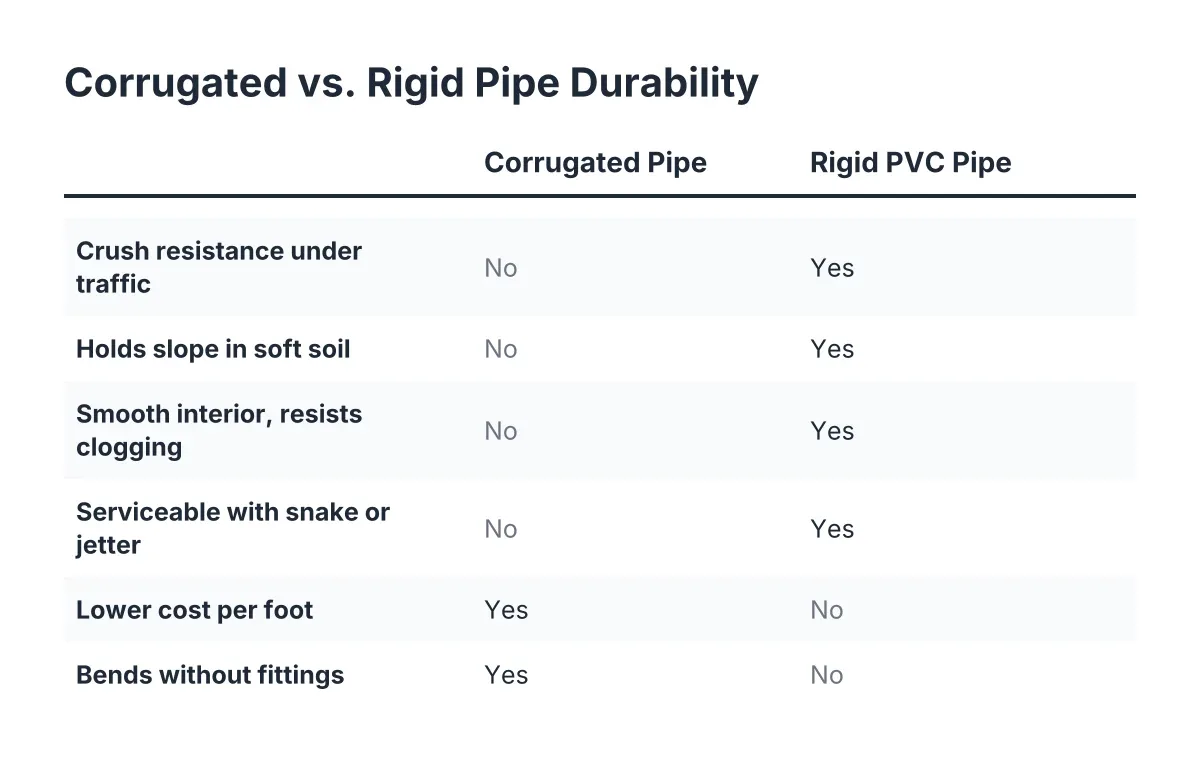
The materials in a French drain are simple, and that is the point. A proper installation layers drainage fabric and washed drainage gravel around a perforated pipe, so water filters in while soil stays out. If you have ever looked at a French drain diagram, this is the cross-section it shows: fabric lining the trench, gravel bedding, perforated pipe, more gravel, and fabric wrapped over the top.
Materials are a modest share of the total. For a typical crawl space perimeter run, the pipe, gravel, fabric, and fittings might account for a quarter or less of the project price. The rest is labor, and in a crawl space, that ratio is fair. Getting several hundred feet of gravel under a house one bucket at a time is the work you are paying for.
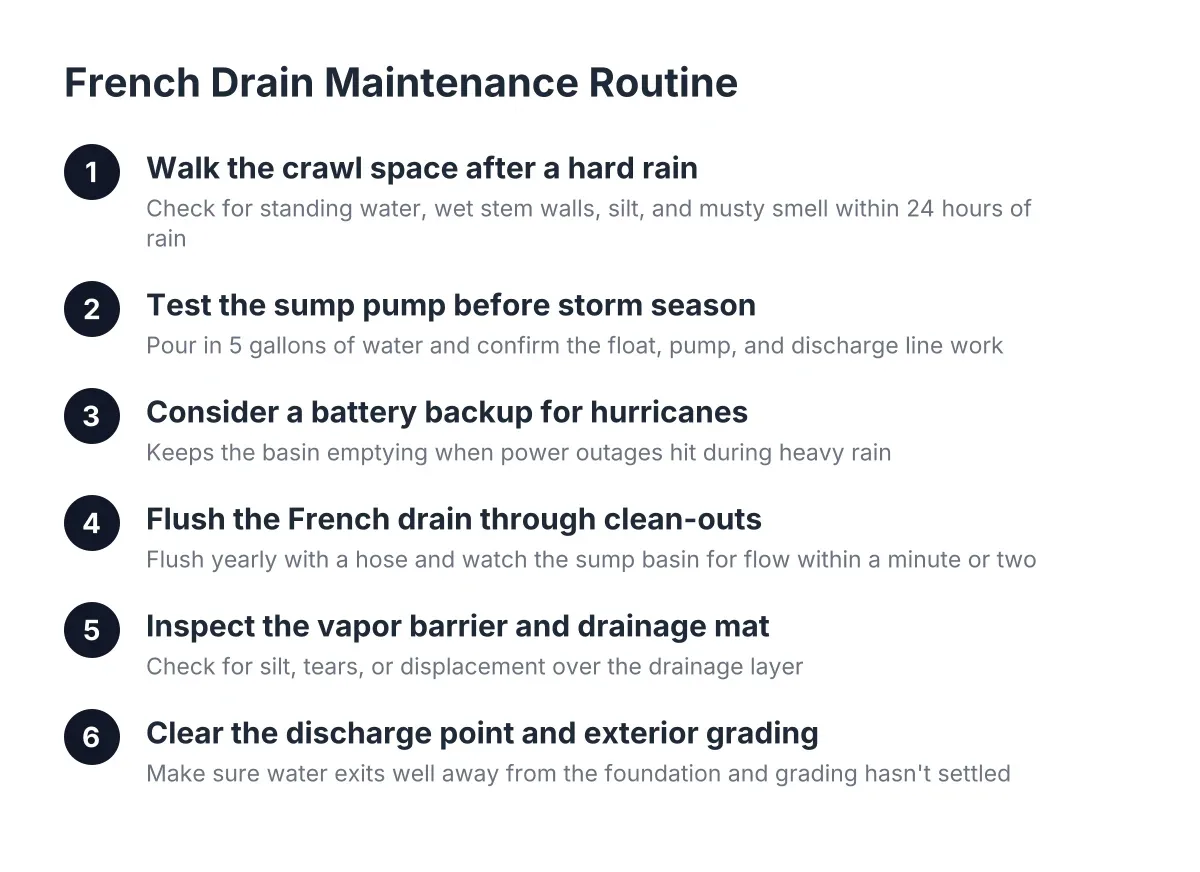
One material detail worth asking about: clean-out access points. A well-built system includes clean-outs on both the French drain and any solid discharge pipe, so the lines can be flushed and serviced years later without digging anything up. Clean-outs add little to the upfront cost and save a great deal down the road. A quote that leaves them out is cutting a corner you will not notice until the drain clogs.
Labor: why the quote is mostly hours
Labor on a crawl space French drain covers more than digging. The crew has to grade the trench to a continuous slope, set the pipe, place and compact gravel, tie in the discharge line, and restore the crawl space floor. In an interior perimeter system, the channel must slope steadily toward the sump basin so water moves by gravity into the pump instead of pooling along the trench. Getting that slope right in a tight space, by hand, is skilled work.
For a rough sense of scale, suppose a homeowner in West Ashley has a 1,400-square-foot house with water pooling along the back foundation wall after every heavy rain. A typical crew might install 80 to 120 feet of interior perimeter drain tied to a sump basin. As an illustrative estimate, a project like that in 2026 often lands somewhere in the $3,000 to $7,000 range depending on depth, access, and whether the discharge can run by gravity. A full perimeter on a larger or lower house, with difficult access and a pump system, can run higher. These are estimates to frame your thinking, not quotes; your crawl space sets your price.
The sump pump question
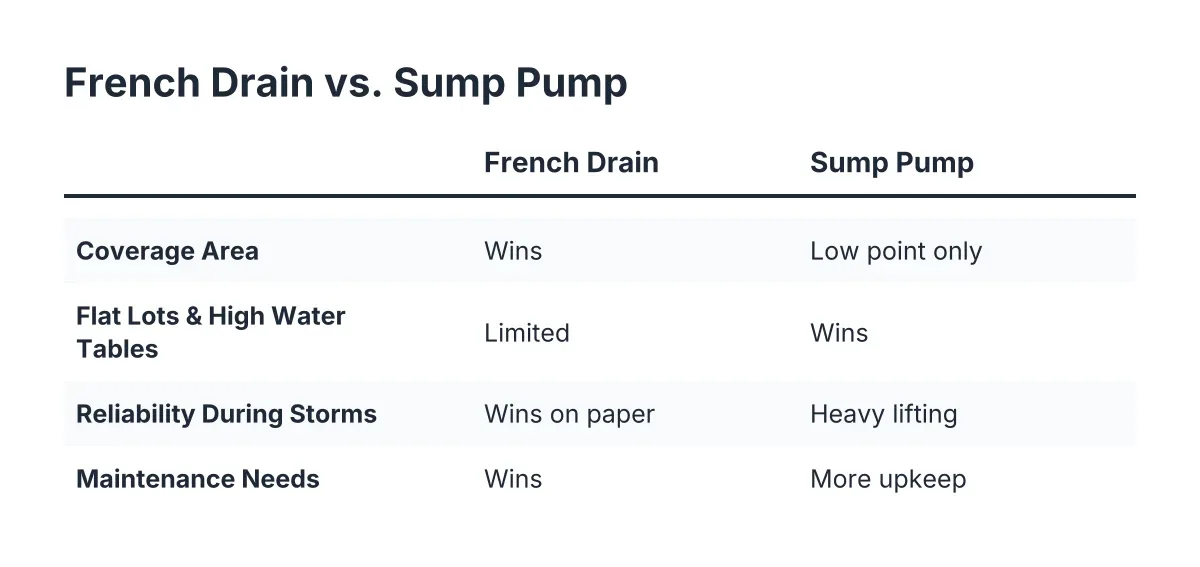
Not every French drain needs a pump. When the trench is deep enough and the lot has natural fall toward a ditch or lower ground, gravity can carry water away on its own, and that is the cheapest version of the system to own. In flat, low Charleston neighborhoods, though, there is often nowhere downhill to send the water. In that case the drain channels water to a sump basin, and a pump lifts it out to a discharge point away from the house.
A perimeter drain installed along the interior of the crawl space foundation wall is designed to intercept water coming in under the foundation and channel it to a sump pump, according to Building America Solution Center (PNNL/DOE). The pump, basin, check valve, and discharge line add to the project cost, and a battery backup adds more. For homes in flood-prone or tidal areas, that backup earns its keep the first time a storm knocks the power out while the water is still rising.
How Much Should a French Drain Cost to Install Under a House?
A crawl space French drain in the Charleston area, installed by a professional, generally costs more per foot than the yard drains priced in national cost calculators, because the digging is by hand and the conditions are wet. As an illustrative range for 2026, partial runs often fall in the low thousands, while full interior perimeter systems with a sump pump commonly land between roughly $4,000 and $10,000. Site conditions move that number more than anything else.
Be careful with online French drain cost calculators and per-linear-foot figures. Most of them price exterior yard drains, where a machine digs the trench in an afternoon. A cost per foot that is realistic for a lawn is not realistic for an 18-inch crawl space with one small access door. When you compare quotes, compare scope, not just footage: trench depth, gravel quantity, fabric, clean-outs, sump equipment, discharge routing, and cleanup should all be itemized.
The DIY question comes up often, and it deserves a straight answer. Materials for a French drain are affordable, and in an open yard with good access, handy homeowners do install them. Under a house is different. The digging is brutal, the slope has to be continuous and correct, and a mistake buried under a vapor barrier is expensive to find later. If your crawl space is tall, dry enough to work in, and the run is short, DIY can pencil out. If the space is tight, wet, or the layout needs a pump, the labor you are avoiding is exactly the labor worth paying for.
When a French Drain Is the Wrong Fix for a Musty House
A French drain fixes water problems, not humidity problems. This distinction saves homeowners thousands of dollars, so it is worth sitting with. If your house smells musty but there is no standing water under it, a drain will not fix the smell. The musty smell in many Charleston homes comes from damp air, not pooled water: humid outside air flows through vented crawl spaces all summer, condenses on cool framing and ductwork, and feeds mold growth on wood and insulation.
A French drain and sump pump address flooded crawl spaces and foundation drainage. They do not address a mold problem driven by humidity. That situation calls for moisture control measures like a sealed vapor barrier, closed vents, and a crawl space dehumidifier, and possibly mold remediation first if growth is already established.
However, the two problems often show up together here. A crawl space that floods during storms and runs 80% humidity between them needs both drainage and moisture control. This is where crawl space drainage systems fit into a larger picture: the drain and sump pump handle liquid water, the vapor barrier and dehumidifier handle water vapor, and encapsulation ties the whole floor together. According to the U.S. Department of Energy, true encapsulation means running plastic sheeting across the entire crawl space floor and sealing it to the stem walls and around support piers, not just laying plastic loosely on the dirt.
If you are skeptical of being sold a $10,000 package when a $300 dehumidifier might do, that skepticism is reasonable, and a scaled approach honors it. Start by finding out which problem you actually have:
- Standing water after rain, dry otherwise: drainage is the fix. A French drain and sump pump, sized to the problem.
- No standing water, but damp air and a musty smell: moisture control is the fix. Vapor barrier, sealed vents, dehumidifier.
- Both water and humidity: drainage first, then encapsulation. Installing a sealed liner over an active water problem traps the water, which is worse than leaving it alone.
- Water plus soft or sagging floors: get a structural inspection before anything else. Long-term moisture can rot beams and joists, and drainage will not undo damage already done.
A crawl space inspection with photos should tell you which category you are in. Any contractor who quotes a full system without showing you what is under your house has skipped the step that matters most.
Drainage Costs in a Pre-Sale Crunch
Crawl space water findings sink deals, and they sink them late. Say a seller in Mount Pleasant is three weeks from closing when the buyer's inspection report flags standing water and a failed vapor barrier under the house. The buyer's agent wants it fixed or credited before the walkthrough. In that scenario, the seller needs two things fast: an accurate scope and documentation.
For sellers in that position, a few points help:
- A targeted drain in the wet section of the crawl space costs less than a full perimeter system, and if the inspection only flagged localized water, a targeted fix may satisfy the repair request.
- Get the repair scope in writing with photos before and after. Buyers and their agents accept documented work far more readily than a verbal assurance.
- Grading matters. Sloping the crawl space dirt toward the drain before any liner goes down helps water reach the perimeter drain instead of pooling in the middle, according to Building America Solution Center (PNNL/DOE). It is a detail inspectors notice.
- If the buyer is asking for encapsulation, remember the order of operations. Drainage goes in before the liner, not after.
Buyers can use the same logic in reverse. If an inspection flags crawl space water on a house you want, a realistic drainage repair estimate turns a scary unknown into a line item you can negotiate. About 15% of American homes have a crawl space foundation, according to JSE Labs, and in Charleston's older neighborhoods the share is far higher, so lenders and local agents see these findings constantly. A flagged crawl space is a negotiation point, not automatically a dealbreaker.
Questions to Ask Before You Sign a Drainage Quote
The quotes you gather will vary, sometimes by thousands of dollars. The spread usually reflects differences in scope, not greed, so your job is to make the scopes comparable. Ask every contractor the same questions:
- How deep will the trench be, and will it reach footer depth where groundwater enters?
- Does the price include drainage fabric and washed gravel around the pipe, or just the pipe?
- Where does the water discharge, and does the route rely on gravity or a pump?
- Are clean-outs included on the drain and the discharge line?
- How will the crew handle my access door size and crawl space height, and did they measure both?
- If a sump pump is included, what happens when the power goes out during a storm?
- Will the crawl space dirt be graded toward the drain before any vapor barrier goes down?
One honest limitation to keep in mind: a French drain manages water, it does not stop it from existing. On the lowest tidal lots, during a major flood event, water may still enter faster than any system can move it. A well-built system drastically shortens how long water sits under your house, and that is what protects the wood. If your home has repeated deep flooding rather than recurring shallow water, talk to a professional about whether drainage, grading, or a combination makes sense before spending anything.
The bottom line for Charleston homeowners is this: the cost of a French drain here is driven by hand excavation, access, depth, and whether a pump is required, far more than by the pipe and gravel themselves. Price the fix for the problem you actually have, insist on an inspection with photos first, and make every quote itemize the same scope. Water under a Lowcountry house is normal. Letting it sit there, season after season, is the part that gets expensive.
If you need crawl space encapsulation, Low Country Crawl Space Repair can help.
Prefer to talk it through? Call +18542013678 — a quick call is usually the fastest way to get a straight answer for your situation.