Corrugated Drain Pipe vs. Rigid Pipe for Charleston Crawl Space French Drains
You crawled under the house after the storm, shined a light across the dirt, and saw standing water where your foundation piers meet the ground. Now you are researching French drains, and you keep hitting the same question: should you choose corrugated versus rigid pipe? The choice matters more in Charleston than almost anywhere else, because our high water table, tidal lots, and heavy summer downpours punish a drainage system year after year. This guide compares both pipe types honestly, explains which one holds up under a Lowcountry crawl space, and shows you what a properly built system should include so the water stops coming back.
More than 60% of homes in the U.S. have had water or moisture problems in their basement or crawl space, according to the American Society of Home Inspectors. In Charleston, with our storm cycles and flood-prone peninsula lots, the odds run worse. Charleston set a record of 17 high-tide flood days during the 2023 to 2024 meteorological year, according to NOAA Tides and Currents. When the ground around your home is that wet that often, the pipe you bury under your house needs to last. That is the whole argument of this article.
What Corrugated Drain Pipe Is, and How Rigid Pipe Differs
Corrugated drain pipe is flexible black plastic tubing, usually high-density polyethylene, with ridges running around its circumference. Those ridges let the pipe bend around obstacles without fittings. It comes in long coils, often 100 feet, and it is cheap and light. You have probably seen a corrugated drain tube running off a downspout in a neighbor's yard. That is its most common job.
Rigid pipe, in drainage work, usually means PVC. French drain pipe in PVC comes in straight 10-foot sticks with a smooth interior wall. It does not bend. Every turn requires a glued fitting. It costs more per foot and takes longer to install. Both types come in perforated versions, with holes or slots that let groundwater enter the pipe, and solid versions that carry water to a discharge point without letting any in or out along the way.
A French drain works the same way regardless of which pipe sits inside it. A trench gets dug, lined with drainage fabric, and partially filled with gravel. The perforated pipe lies in that gravel bed, wrapped so soil cannot clog it. Water in the surrounding soil finds the path of least resistance, enters the pipe through the perforations, and flows downhill toward a sump basin or a gravity discharge point. The pipe is the highway. The question is which highway survives decades of Charleston groundwater, foot traffic, and settling soil.
Rigid PVC vs. Corrugated Pipe: The Durability Comparison
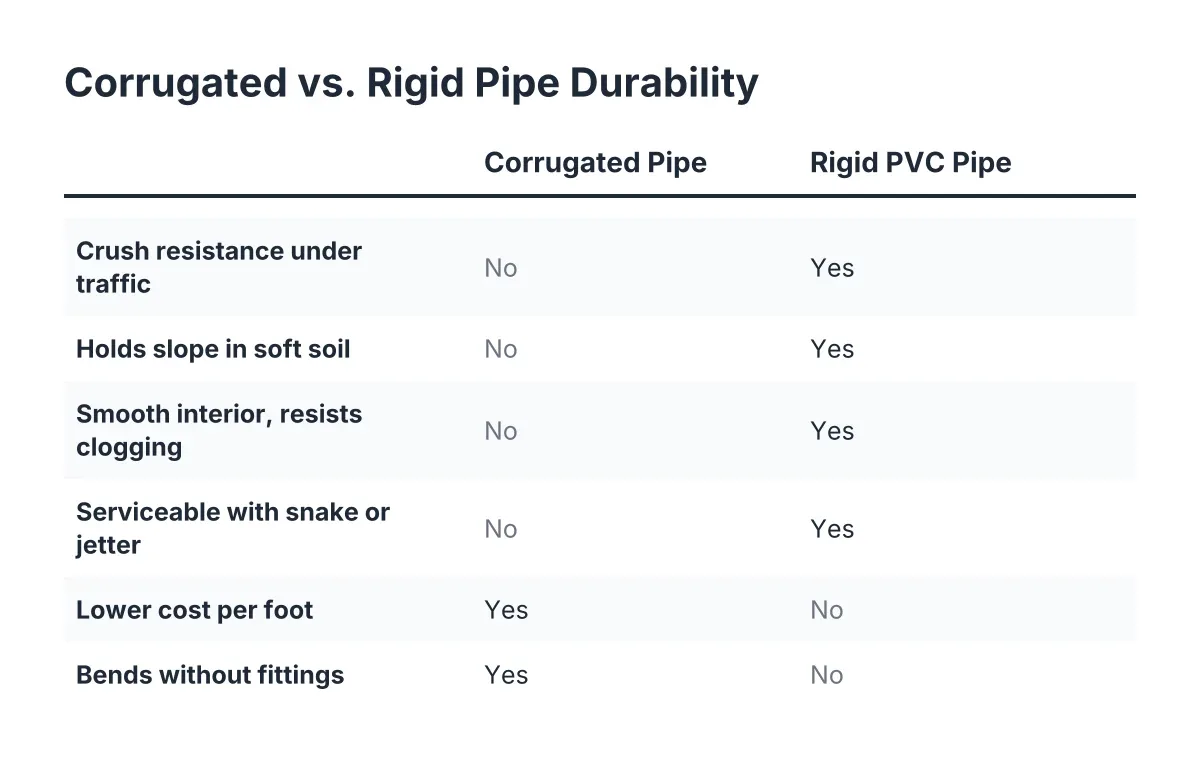
Rigid PVC outlasts corrugated pipe in a crawl space drainage application, and the gap is not close. Corrugated pipe crushes under point loads, sags between support points, and clogs more easily because of its ridged interior. PVC holds its shape, holds its slope, and can be cleaned out with a jetter or snake for decades. Here is why each of those differences matters under your house.
Crush resistance under a working crawl space
A crawl space is not an empty void. Technicians crawl through it to service HVAC ducts, plumbing, and wiring. Encapsulation crews walk across it during vapor barrier installation. Corrugated pipe buried in a shallow trench can deform under a knee or a boot, especially the thin-wall varieties sold in big coils. Once the pipe ovals or flattens, its flow capacity drops and debris starts catching at the pinch point.
Rigid PVC resists that kind of point loading. A schedule 40 or SDR 35 pipe buried in a gravel bed will hold its round shape under normal crawl space traffic. For a system you expect to work during every tropical storm for the next 20 or 30 years, that stiffness is worth the extra cost per foot.
Slope integrity in soft Lowcountry soil
A drainage trench only works if it slopes continuously toward the sump basin so water moves by gravity instead of pooling in the line. Charleston's sandy, often saturated soils settle. A flexible corrugated drain pipe follows the soil as it settles, developing low spots called bellies. Water sits in a belly, sediment drops out of the standing water, and over a few years the belly becomes a clog.
In contrast, rigid pipe bridges small soil movements. A 10-foot PVC stick bedded in compacted gravel keeps its grade even when the soil beneath one section softens. Slope integrity is the single biggest durability argument for rigid pipe in a crawl space, because a drain that loses its slope fails quietly. You will not know until the next storm puts water back under the house.
Interior wall smoothness and clogging
The ridged interior of corrugated pipe catches silt, sand, and iron ochre, the orange bacterial slime common in Lowcountry groundwater. Each ridge is a little shelf where sediment builds. Smooth-wall PVC gives debris nothing to grab. Water moves faster through it at the same slope, which helps flush fine sediment through to the sump basin instead of leaving it in the line.
Serviceability over decades
A well-built system includes clean-out access points for both the French drain and any solid discharge pipe. Rigid PVC accepts a mechanical snake or water jetting without damage. Corrugated pipe can tear or deform under a cleaning tool, and its ridges deflect the tool head. If a drain cannot be serviced, its real lifespan is however long it takes to clog. That is the practical answer to the choice between rigid and corrugated pipe: PVC is the pipe you can maintain, so it is the pipe that lasts.
Where Corrugated Pipe Still Earns Its Place
Corrugated pipe is not junk; it is a tool with a narrower job. It makes sense in low-stakes yard drainage where cost matters more than lifespan, and where digging up a failed line is a Saturday project instead of a crawl space excavation.
Reasonable uses for corrugated pipe around a Charleston home include:
- Downspout extensions carrying roof water away from the foundation, where the pipe runs shallow and gets replaced easily
- Temporary drainage during construction or landscaping
- Long gentle yard runs with no vehicle or foot traffic, where flexibility avoids dozens of fittings
- A perforated T-intersection added to a downspout line, giving roof water a larger soil area to drain into well away from the house
Notice what is not on that list: anything under the house. The crawl space is the one place where a failed drain costs the most to discover, access, and replace. Suppose a homeowner on the peninsula saves a few hundred dollars using coiled corrugated pipe in an interior perimeter drain. Five years later a belly forms, the line clogs, and the next tropical storm puts two inches of water back under the heart-pine floors. In that scenario, the repair means pulling back the vapor barrier, re-excavating the trench by hand in a 24-inch-tall crawl space, and rebuilding the drain. The original savings disappear several times over.
How a Rigid Pipe French Drain System Goes Together Under a Charleston Home
A crawl space French drain built to last starts before any pipe goes in. The crew grades and levels the crawl space dirt first, sloping it slightly toward the drain, which helps water flow into the perimeter trench instead of pooling in the middle, a practice described by the Building America Solution Center (PNNL/DOE). On a pre-1950s pier-and-beam home downtown, this grading step also reveals old debris, construction rubble, and low spots that have collected water for decades.
From there, a typical installation follows this sequence:
- Dig a perimeter trench along the interior of the foundation or stem wall, sized for pipe and gravel.
- Line the trench with drainage fabric to keep Charleston's fine sandy silt out of the gravel bed.
- Bed perforated rigid pipe in washed gravel, set at a continuous slope toward the sump basin.
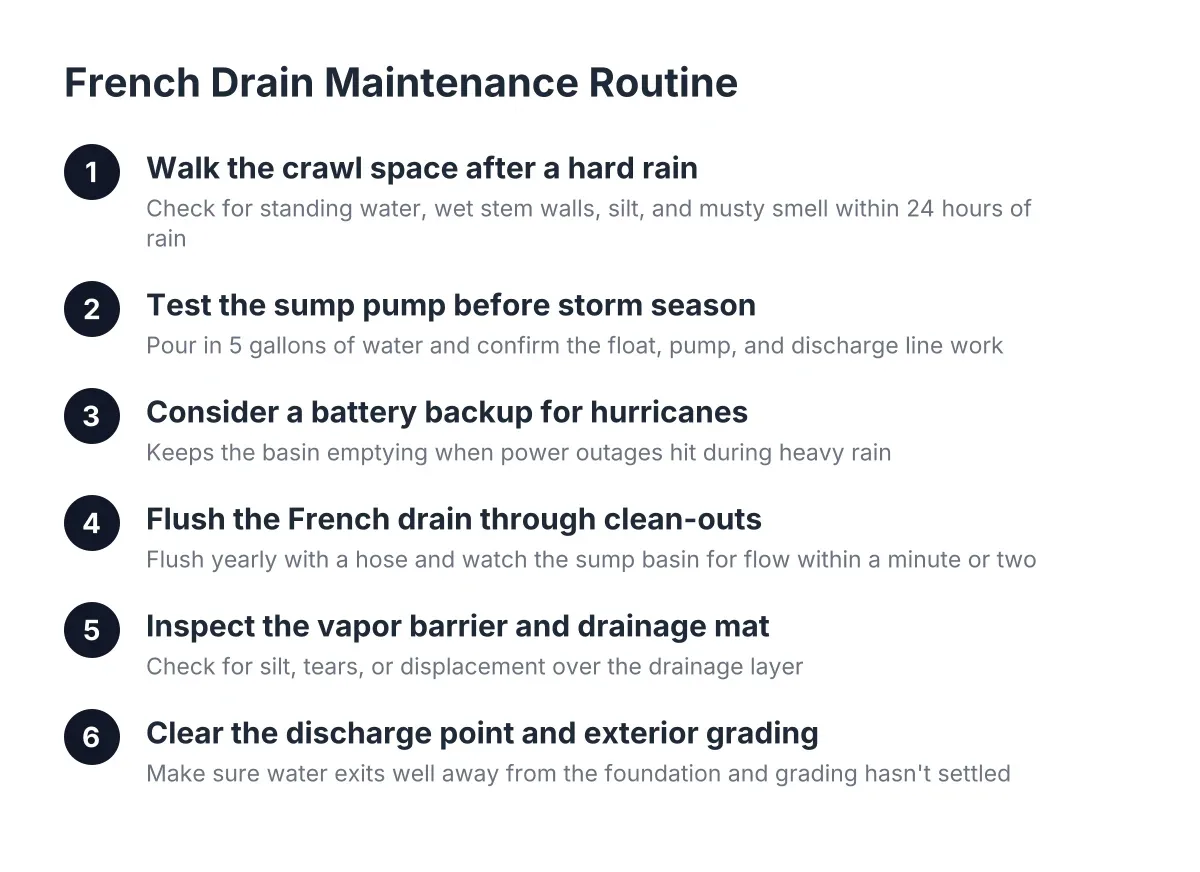
- Install clean-out access points so the line can be inspected and jetted in the future.
- Set the sump basin at the low point and install the pump with a solid discharge line carrying water well away from the foundation.
- Wrap the fabric over the gravel and restore grade.
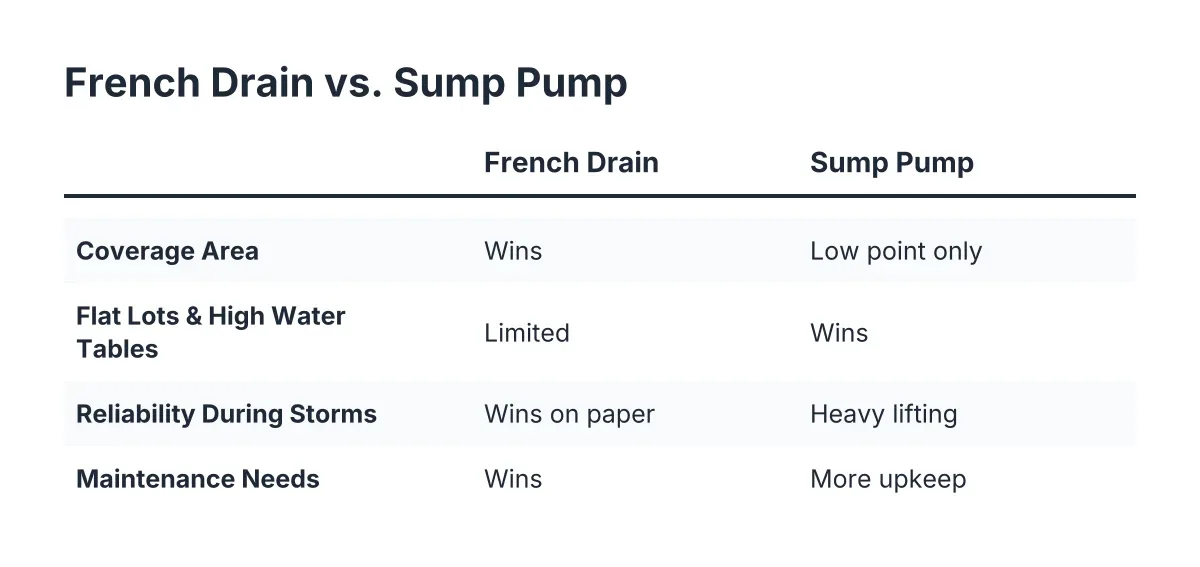
A perimeter drain installed around the interior of a crawl space foundation wall intercepts water entering under the foundation and channels it to a sump pump, according to the Building America Solution Center (PNNL/DOE). On some elevated lots with real fall away from the house, a deep enough trench with natural slope can drain by gravity alone, no pump needed. On the flat, high-water-table lots common downtown and on Sullivan's Island, a sump pump for the crawl space is usually non-negotiable, because there is nowhere for gravity to send the water.
If the home is getting encapsulation too, the drainage goes in first. Encapsulated crawl space floors are typically built up with several inches of gravel beneath the vapor barrier, with drainage piping around the foundation perimeter, per the Building America Solution Center (PNNL/DOE). Pipe choice matters here as well: a rigid line under a sealed liner should not need attention for decades, which is exactly the point.
What a Full Crawl Space Drainage Scope Includes, and What Costs Extra
When you get quotes, you want to compare complete systems, not just pipe footage. A fair scope for crawl space drainage systems in the Charleston area generally covers grading, trenching, fabric, gravel, perforated pipe, a sump basin and pump, a solid discharge line, and clean-outs. Items that often price separately include standing water removal before work starts, debris and old insulation cleanup, mold remediation if fungal growth has already taken hold, a battery backup pump, a dehumidifier, and full encapsulation with a sealed vapor barrier.
Costs vary widely with crawl space height, access, linear footage, and soil conditions, so treat any flat number you read online with suspicion. As an illustrative estimate, interior perimeter drainage with a sump pump in this market commonly lands in the low-to-mid four figures for a modest footprint, while a historic peninsula home needing drainage plus encapsulation and structural work can run well into five figures. Timeline-wise, a straightforward drainage installation is usually a matter of days, not weeks, though tight access under a historic home slows everything down. Ask each bidder to state their timeline in writing.
One honest caveat: a French drain and sump pump solve standing water and foundation drainage problems. They do not fix a musty smell or mold problem driven by humidity alone. If your crawl space is damp year-round but never floods, the right fix may be a vapor barrier, sealed vents, and a dehumidifier rather than trenching. A good inspection sorts out which problem you actually have before anyone sells you a system.
DIY or Hire a Pro for Crawl Space Drainage?
Handle the small stuff yourself and bring in a specialist for anything under the house. A homeowner can safely extend downspouts, regrade mulch beds so surface water flows away from the foundation, and clear gutter clogs that dump roof water at the stem wall. Those fixes cut the volume of water reaching the crawl space and cost little.
However, interior perimeter drains belong to a pro. Digging a continuously sloped trench while lying on your side in 20 inches of clearance, around piers that carry your house, is miserable and risky work. Get the slope wrong by half an inch over a long run and the system fails. Undermine a brick pier on a 1920s home and you have created a foundation repair problem bigger than the water problem. Call for professional help now if you see standing water that lingers more than a day or two after rain, white mineral staining on piers, soft or sagging floors above the crawl space, or visible fungal growth on joists. On a high-value historic home, it is also worth having a structural engineer look at any pier or beam concerns before drainage work begins.
Charleston-Specific Factors That Shape the Pipe Decision
Local conditions push the corrugated versus rigid pipe decision harder toward rigid here than in drier markets. The water table under much of the peninsula and the barrier islands sits close to the surface, so a crawl space drain may carry water for weeks at a stretch, not just during storms. A pipe that works that often has no slack for bellies or crushed sections.
Tidal influence matters too. On low-lying lots, groundwater rises and falls with the tide, cycling water through the drain daily. Hurricane season stacks heavy rain on saturated soil from June through November, which is when a weak link in the system shows itself. In addition, many older Charleston homes have vented masonry or pier-and-beam crawl spaces with limited clearance, which makes future repairs expensive; that raises the value of installing the longer-lived pipe the first time. Historic district properties may also face review requirements for exterior work, which is one more reason interior perimeter drainage is often the practical route downtown.
Choosing an Installer: Three Questions That Reveal Quality
First, ask what pipe they install and why. A contractor who defaults to coiled corrugated tubing under the house to hit a low bid is telling you how they think about lifespan. A specialist should be able to explain the rigid pipe choice in terms of crush resistance, slope retention, and serviceability.
Second, ask how they establish and verify slope, and whether the system includes clean-outs. A continuous grade toward the sump basin, confirmed with a level or laser rather than eyeballed, separates a drain that works for decades from one that works for two years. Clean-outs on both the French drain and the solid discharge line show the installer expects the system to be maintained, not abandoned.
Third, ask what the quote includes beyond the drain itself. A fair quote itemizes grading, fabric, gravel, pipe type and footage, basin and pump model, discharge routing, and cleanup. Vague line items like "drainage system, lump sum" make it impossible to compare bids. If one bid is far cheaper, the difference is usually in the pipe, the gravel depth, or the pump.
Stop the Water for Good
Standing water under your house after every hard rain is a drainage problem with a known fix: a graded crawl space, an interior perimeter French drain built with rigid perforated pipe, and a sump pump sized for Charleston's water table. Corrugated and rigid pipe each have their strengths, but under the house, durability wins, and rigid PVC is the durable choice.
If you just found water under your home, or you are tired of finding it after every storm, have a Charleston crawl space specialist inspect the space and scope the right system. Low Country Crawl Space Repair handles drainage, sump pumps, encapsulation, and the moisture control work that follows, and an inspection will tell you exactly what your crawl space needs before you spend a dollar on the wrong fix. Reach out to schedule an estimate.
If you need crawl space encapsulation, Low Country Crawl Space Repair can help.
Prefer to talk it through? Call +18542013678 — a quick call is usually the fastest way to get a straight answer for your situation.