Crawl Space Repair for Home Sale — Complete Guide
crawl space repair home — The Complete Guide
A crawl space finding on a home inspection report can stall a sale faster than almost any other issue. If you're selling a Charleston-area home and the buyer's inspector flagged moisture, mold, or sagging floors, you need a crawl space repair home sellers can complete on a closing timeline, not a vague estimate weeks out. This guide walks you through what inspectors and buyers actually flag, how fast repairs like encapsulation and mold remediation can realistically happen, and what documentation you need to satisfy the buyer's agent and lender. You'll also learn how repair credits work when there's no time to fix everything before closing. Everything here reflects Lowcountry ground truth: coastal humidity, high water tables, and the vented pier-and-beam crawl spaces common under older Charleston homes.
What You'll Find in This Guide
Coming soon — we're building out this topic cluster.
Why Crawl Space Findings Derail Charleston Home Sales
Crawl space problems surprise sellers more than almost any other inspection item. That's because most homeowners never go under their house. The buyer's inspector does, and in the Lowcountry, that inspector almost always finds something.
Moisture is the most common flag. According to the American Society of Home Inspectors, more than 60% of U.S. homes have had water or moisture problems in their basement or crawl space. In Charleston, that number feels conservative. High water tables, tidal lots, and year-round humidity push moisture into vented crawl spaces almost by design. NOAA Tides and Currents recorded 17 high-tide flood days in Charleston during the 2023–24 meteorological year, a record for the city. When the ground stays that wet, standing water and saturated soil under a house become routine findings, not rare ones.
The Findings That Show Up on Inspection Reports
Beyond standing water, inspectors typically flag a predictable set of issues. Common findings include:
- Mold or fungal growth on floor joists, which triggers immediate buyer anxiety and often a remediation demand
- Sagging or damaged vapor barriers
- Wet or fallen insulation
- Wood rot at beams and sill plates
- Rusted or shifting support piers
- Musty odors migrating into the living space, pointing to air quality problems the buyer will notice during their walkthrough
Structural notes carry the most weight with lenders. For example, a comment about a compromised beam or an undersized pier can prompt the buyer's lender to require repair before funding the loan. That turns a negotiable item into a hard requirement.
Why Charleston Homes Are Especially Exposed
About 15% of American homes sit on a crawl space foundation, according to JSE Labs. In the historic Charleston area, the share runs far higher because raised pier-and-beam construction was the standard response to flood-prone, low-lying lots. Those older homes were built with open foundation vents, which pull humid coastal air under the house all summer. As a result, condensation forms on cool framing and ductwork, and mold follows. If you're selling an older Lowcountry home, assume the crawl space will be a topic in negotiations and plan for it early. In short, a proactive crawl space repair home strategy saves sellers from last-minute scrambles once the inspection report lands.
How Fast Can a Crawl Space Repair Home Sale Timeline Really Move?
The question every seller asks first: can this be fixed before closing? In most cases, yes. Crawl space work moves faster than sellers expect, because the scope is usually well defined once a specialist inspects the space. However, speed depends on getting an accurate assessment quickly and choosing a contractor who works transaction deadlines every week.
Typical Turnaround by Repair Type
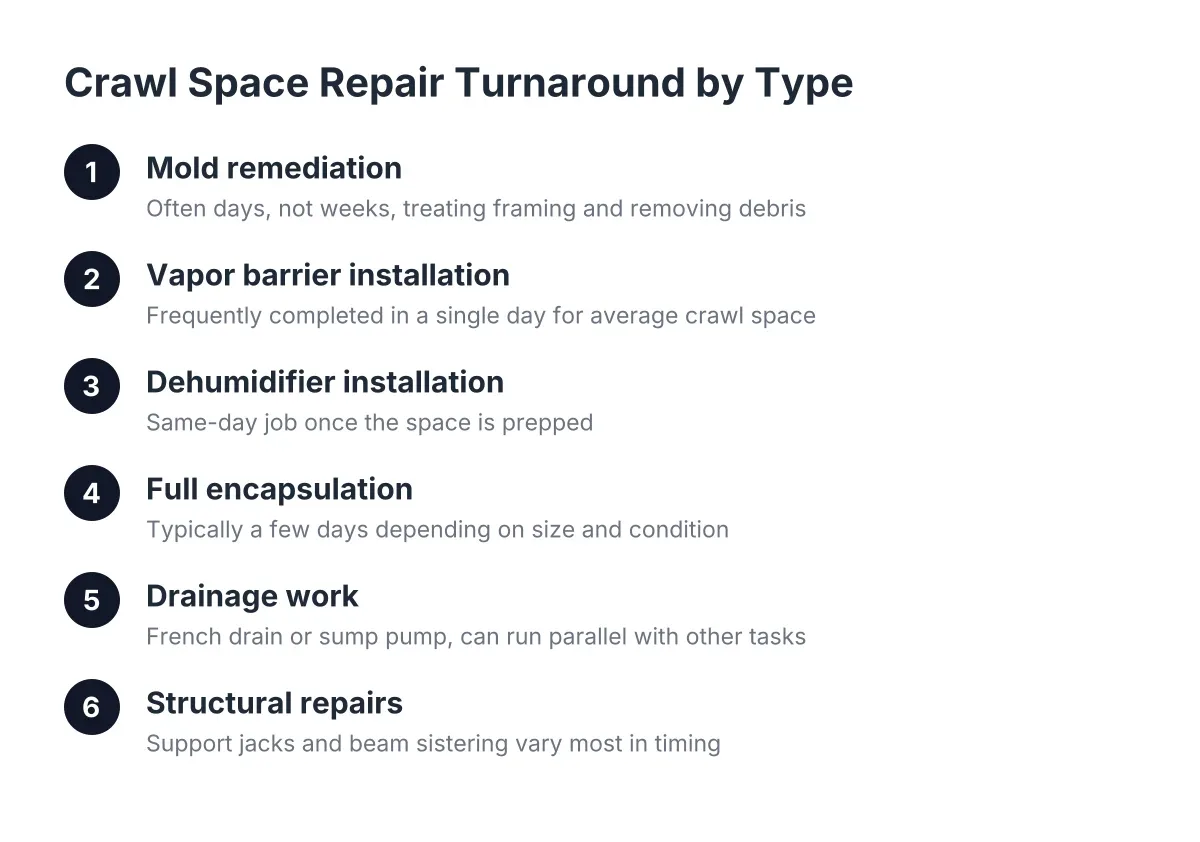
Turnaround varies by the type of work needed, but most jobs move quickly once a crew is on-site:
- Mold remediation is often a matter of days, not weeks. The crew treats affected framing, removes contaminated insulation and debris, and addresses the moisture source so the problem doesn't return before the buyer's re-inspection.
- Vapor barrier installation frequently wraps up in a single day for an average-sized crawl space.
- Dehumidifier installation is a same-day job once the space is prepped.
- Full encapsulation, which seals the crawl space with a heavy liner, seals the vents, and adds dehumidification, typically takes a few days depending on the size and condition of the space.
- Drainage work such as a French drain or sump pump adds time, but a coordinated crew can often run it in parallel with other tasks.
- Structural repairs like support jacks and beam sistering vary the most, though many stabilization jobs still finish within the window of a standard due diligence or repair period.
What Actually Slows Repairs Down
Delays rarely come from the work itself. Instead, they come from scheduling gaps, standing water that must be pumped and dried before crews can start, and scope changes discovered mid-job. For example, a crew replacing a vapor barrier may uncover rot the inspector's flashlight missed. With this in mind, get a specialist under the house as soon as the inspection report lands. An early, thorough assessment protects your timeline far better than a fast quote based on someone else's photos.
One more timing note: hurricane season compresses everyone's schedule. Moisture calls spike after tropical systems, so if your closing falls between June and November, book the assessment the same week you receive the buyer's repair request. Planning around that seasonal surge is one of the simplest ways to keep a crawl space repair home project from sliding past your closing date.
Documentation, Receipts, and Negotiating a Crawl Space Repair Credit
Fixing the crawl space is only half the job when a sale is on the line. The other half is proving the work was done, done right, and done by someone qualified. Buyers' agents have seen too many hasty pre-closing patch jobs. Consequently, the quality of your paperwork often matters as much as the quality of the repair.
The Paper Trail Buyers' Agents Expect
At minimum, you need an itemized invoice marked paid that describes the scope of work in plain language. A receipt that says "crawl space work, $4,800" invites questions. In contrast, an invoice listing mold remediation of specified joists, removal of contaminated insulation, installation of a sealed vapor barrier, and a dehumidifier with model number closes the conversation. A solid documentation package for a crawl space repair home sale typically includes:
- An itemized, paid invoice describing the scope in specific terms
- Before-and-after photos, so the buyer's agent can verify the work without crawling under the house
- A written statement of moisture readings or conditions at completion
- Any transferable warranty on the encapsulation system or structural components
Additionally, before-and-after photos carry real weight because they let the buyer's agent confirm the scope firsthand. Transferable warranties are a genuine selling point, so put them in front of the buyer's agent rather than waiting to be asked.
If mold was the finding, some buyers request post-remediation verification. To put it simply, decide early whether your buyer will want third-party clearance, because that adds a step to the schedule.
When a Credit Beats a Repair
Sometimes the closing date arrives before the work can. In that situation, a repair credit or price reduction keeps the deal alive. Credits work best when the scope is clearly priced. Therefore, get a written, itemized estimate from a crawl space specialist even if you don't intend to do the work yourself, because that number anchors the negotiation. Without it, buyers pad their ask to cover uncertainty, and you overpay for the unknown.
Beyond that, be aware of what a credit can't solve. Lenders sometimes refuse to fund a loan on a home with documented structural deficiencies, regardless of credits. In those cases, the structural repair must happen before closing, while cosmetic and moisture items can shift to a credit. Radon can also surface in Lowcountry transactions. The average indoor radon level in South Carolina is about 1.9 pCi/L, above the national average of 1.3 pCi/L, according to Radon.org, and sealed encapsulation work pairs naturally with mitigation planning if the buyer tests. For guidance on moisture and indoor air standards more broadly, the EPA's mold resources are a useful reference point for both sides of the transaction.
Choosing the Right Contractor for a Deadline-Driven Crawl Space Repair Project
Not every contractor fits a real estate timeline. General handymen, pest control companies offering add-on moisture services, and national franchises running templated schedules all exist in the Charleston market. However, a transaction under deadline needs a specialist who treats the closing date as the actual scope of the job.
Questions That Reveal Whether a Contractor Can Hit Your Closing
Before hiring anyone, ask a short set of direct questions:
- How many pre-closing repairs has the company completed in the last quarter? A specialist who works with realtors regularly will answer without hesitation.
- What documentation comes standard? If photos, itemized invoices, and completion statements aren't automatic, you'll be chasing paperwork during the busiest week of your sale.
- Who communicates with the buyer's agent? The best outcome is a contractor comfortable answering scope questions directly, because secondhand explanations breed doubt.
- Is the crew in-house or subcontracted? Subcontracted crews introduce scheduling risk you can't afford two weeks from closing.
- Does the warranty transfer to the buyer? A transferable warranty converts a repair from a liability disclosure into a feature your listing agent can promote.
Finally, verify licensing and insurance before signing anything. These basics protect you if a dispute arises after closing.
Local Knowledge Is Not Optional Here
Charleston crawl spaces behave differently than crawl spaces in Atlanta or Charlotte. Tidal influence on the water table, flood-zone drainage rules, and the framing details of century-old pier-and-beam homes all change how a repair should be scoped. For example, sealing vents on a home in a velocity flood zone raises code questions a national call center won't anticipate. A local specialist prices the job right the first time, which protects your timeline from mid-job surprises. In practice, that local fluency is what keeps a crawl space repair home closing on schedule instead of slipping into an extension request.
Ready to Get Started?
If a buyer's inspection just flagged your crawl space, the clock is already running, and the fastest move is a specialist assessment this week. Low Country Crawl Space Repair works Charleston-area transactions on real closing deadlines, with the itemized invoices, photos, and transferable warranties that buyers' agents actually accept. Reach out today, and let's get your crawl space and your sale back on schedule.