Does Crawl Space Repair Add Value When Selling a Charleston Home? A Straight Answer
So does crawl space repair actually add value when you sell a Charleston home, or is it money you never get back? Here is the short version: documented crawl space repair rarely raises your asking price by itself, but it protects the price you already set, keeps your closing on schedule, and takes away the single most common reason Lowcountry buyers walk or demand steep credits. The crawl space resale value hinges on protection rather than price inflation: in a market where inspectors crawl under every raised pier-and-beam house in town, that protection is worth real money.
This guide walks through how the math works, what buyers and their agents actually look for, how fast the work can happen when a closing date is bearing down on you, and what paperwork you need in hand so the deal does not stall.
Why the Crawl Space Decides So Many Charleston Sales
Charleston homes sit on some of the wettest ground in the country. High water tables, tidal lots, flood-zone parcels, and heavy summer storms all push water toward the dirt under your house. NOAA Tides and Currents recorded 17 high-tide flood days in Charleston during the 2023-24 meteorological year, a record for the city. That water does not stay in the street. It moves through soil, and soil is what most local crawl spaces sit on.
Older Charleston homes make it worse in one specific way. They were built with vented crawl spaces on the theory that outside air would dry things out. In a climate with year-round coastal humidity, those vents pull damp air in all summer, where it condenses on cool framing and ductwork. The result is the musty smell, the surface mold on joists, and the standing water after storms that so many sellers discover for the first time when a buyer's inspector sends over photos.
You are not unusual if this is you. According to the American Society of Home Inspectors, more than 60 percent of U.S. homes have had water or moisture problems in their basement or crawl space. The difference in a real estate transaction is that the problem is no longer private. It is in an inspection report, in writing, with photos, and the buyer's agent is using it.
What Happens When the Inspector Finds Water Under the House
Say a homeowner in West Ashley goes under contract in March. The buyer's inspector goes under the house ten days later and finds an inch of standing water near the back pier line, a torn vapor barrier, and white fuzzy growth on three floor joists. None of it surprised the house; it had been happening after every heavy rain for years. It just surprised the sellers, because almost nobody crawls under their own home.
In that scenario, three things happen fast:
- The buyer's agent sends a repair request, usually within days, citing moisture, mold, and drainage.
- The lender or the buyer's insurance may flag the finding, especially if there is visible structural sagging or rot.
- The closing date, already on the calendar, starts working against the seller instead of for them.
At that point the seller has three options: fix it, credit it, or lose the buyer. Each has a cost, and this is where the value question gets concrete.
How Crawl Space Repair Affects Resale Value at Closing
Crawl space repair pays off at closing mainly by preserving your contract price rather than inflating it. A documented fix removes the buyer's strongest leverage, prevents an inflated repair credit, and keeps nervous buyers from walking during the inspection period. The return shows up as a deal that closes on time at the agreed number, not as a line item added to the appraisal. Understanding the true crawl space resale value means recognizing that the benefit arrives as deal protection, not price premium.
Here is why credits usually cost sellers more than repairs. Buyers do not price unknown moisture problems at the contractor's number. They price them at the worst-case number, because they have no idea whether they are inheriting a torn vapor barrier or a rotted beam. Suppose, as an illustrative estimate, the actual fix is drainage work and mold remediation in the range of a few thousand dollars. The buyer's agent may open the credit negotiation at double or triple that, and in a soft week the seller often takes it just to keep the deal alive.
A completed repair with paperwork flips that dynamic. There is nothing left to fear-price, because the condition is documented, corrected, and transferable to the new owner.
There is one honest limitation to state plainly. Crawl space work is like a new roof: buyers expect a dry, sound crawl space, so fixing yours brings the home up to expectation rather than above it. You will not list for more because the crawl space is dry. You will, however, avoid losing thousands in credits, weeks of delay, or the buyer entirely. For most Charleston sellers, that is the value, and it is not small.
Does Encapsulation Increase Crawl Space Resale Value Beyond the Repair?
Crawl space encapsulation can add value beyond a basic repair because it is a visible, verifiable upgrade a buyer can see at the final walkthrough. A sealed white vapor barrier, a dehumidifier, and a sump pump read as a maintained home, and in Charleston's humidity many buyers specifically ask whether the crawl space is encapsulated.
Encapsulation, as the U.S. Department of Energy describes it, means running plastic sheeting across the entire crawl space floor and sealing it to the stem walls and around support piers, not just laying plastic loosely on the dirt. Done right, it cuts moisture at the source instead of chasing symptoms. That matters to the next owner's floors, framing, and air quality, and sharp buyers' agents know it.
There is also a less obvious benefit worth mentioning accurately. Sealing the crawl space floor helps block soil gas from entering the home, including radon. Radon.org puts South Carolina's average indoor radon level at about 1.9 pCi/L, above the national average of 1.3. Encapsulation is not a radon mitigation system by itself, but a sealed ground barrier works in the right direction, and it is a fair point to include in your disclosure packet.
One code note: Stego Industries points out that some states require a termite inspection strip near the top of the foundation wall to stay uncovered by the vapor barrier. A specialist who works Charleston crawl spaces will know the local requirement; it is one more reason this is not a weekend project during a transaction.
How Fast Can the Work Be Done Before Closing?
Most moisture-focused crawl space repairs fit inside a standard due diligence or repair window when the contractor is a crawl space specialist rather than a general contractor fitting you in between kitchen jobs. The sequencing matters more than the raw days, so here is how a deadline-driven job typically breaks down:
- Inspection and scope, usually one visit. A crawl space inspection with photos establishes exactly what the buyer's inspector saw and what it takes to fix it.
- Water removal and cleanup, one to two days. Pumping out standing water, removing wet debris and old fallen insulation, and drying the space.
- Mold remediation, one to three days depending on how much framing is affected. Treating and cleaning joists and subfloor, not just spraying over the problem.
- Drainage and sump pump installation, one to three days. Grading the dirt so it slopes toward a perimeter drain helps water reach the sump basin instead of pooling mid-space, a detail the Building America Solution Center (PNNL/DOE) calls out specifically.
- Vapor barrier or full encapsulation, one to three days. Sealed sheeting across the floor and up the stem walls, with a dehumidifier sized for the space.
- Structural support, variable. Sistering a joist or setting support jacks under a sagging beam can be quick; replacing a rotted main beam takes longer and should always be done by a licensed contractor.
A typical crew can take a wet, musty Charleston crawl space from inspection-report problem to documented fix in one to two weeks for moisture and drainage work. Structural repairs and full encapsulation can stretch that, which is exactly why sellers should get under the house, or get an inspector under it, before listing rather than after going under contract. Timing is the one variable you control.
The Documentation Buyers' Agents Actually Trust
Paperwork is half the value of pre-sale crawl space work. A fix nobody can verify is, to a buyer's agent, not a fix. Before the crew leaves, make sure you walk away with a documentation packet you can hand straight to the listing agent:
- A written scope of work describing the problem found and the repair performed, in plain language.
- Before-and-after photos of the standing water, the mold, the new drainage, and the finished vapor barrier.
- An itemized paid invoice, the crawl space repair receipt many closing attorneys and agents now ask for by name.
- Equipment details for any installed dehumidifier or sump pump, including model and any transferable warranty terms.
- Moisture or humidity readings taken after the work, when available, showing the space is in a healthy range.
This packet does three jobs at once. It satisfies the buyer's repair request in writing. It gives the buyer's agent something concrete to show their client. In addition, it becomes part of the home's record, which helps if the sale falls through and you relist. Sellers who treat crawl space repair for home sale as a documentation exercise as much as a construction job close faster and renegotiate less.
One practitioner reality worth knowing from the buyer's side: when sellers manage repairs under deadline, the temptation is to hire the cheapest available crew. That is precisely why documentation matters. Named equipment, photos, and an itemized invoice from a crawl space specialist are what separate a trustworthy pre-closing fix from a cosmetic one, and experienced agents can tell the difference.
Repair, Credit, or Walk: How the Negotiation Usually Plays Out
When a buyer requests crawl space repair, the seller's best move depends on time, severity, and the buyer's temperament. A quick decision framework:
- Fix it when the problem is moisture, drainage, or surface mold and your closing is three or more weeks out. You control the scope, the cost, and the paperwork.
- Credit it when the issue is structural and complex, or the timeline is too tight to do the work right. Some buyers actually prefer a credit so they can choose their own contractor after closing and oversee the work themselves; do not fight that preference, price it fairly.
- Split it when the buyer wants the moisture handled now but is comfortable crediting the encapsulation upgrade. Common and workable.
However you land, get the agreement in writing with the scope defined. "Seller to address crawl space moisture" is a dispute waiting to happen. "Seller to install perimeter drainage, sump pump, and sealed 12-mil vapor barrier per attached scope" closes clean.
Common Questions Charleston Sellers Ask Mid-Transaction
Will a sump pump alone satisfy the buyer?
A sump pump alone rarely satisfies a buyer whose inspector documented standing water, because the pump handles water that arrives but does nothing about the humidity, mold, or torn vapor barrier already noted in the report. In a sealed crawl space, the Building America Solution Center (PNNL/DOE) describes the sump pump as an emergency backstop at the lowest point of the space, not the primary moisture control. Buyers' agents generally want the drainage path, the barrier, and any mold addressed together.
Is the mold finding a dealbreaker?
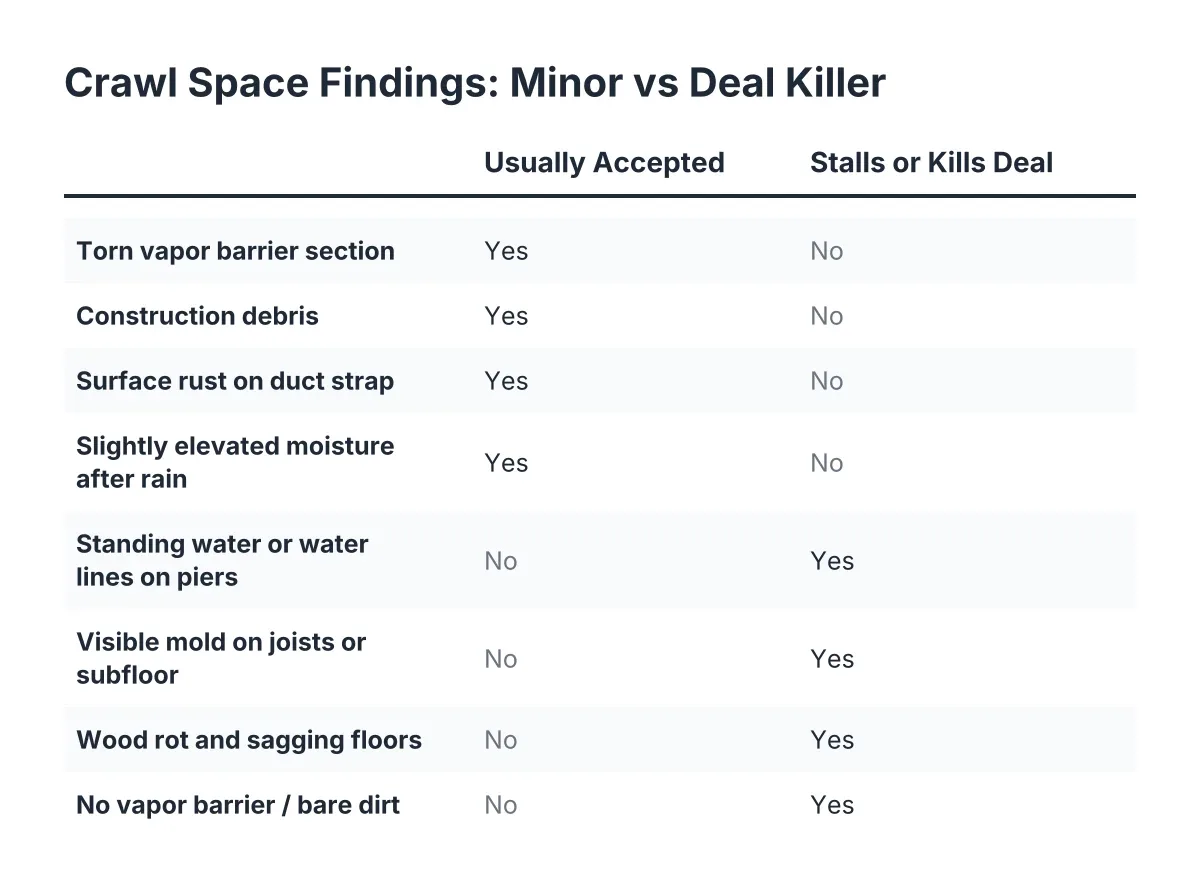
Mold in a Charleston crawl space is common, not catastrophic, and it almost never kills a deal that is handled quickly and documented. Given the humidity here, surface growth on joists shows up in a large share of inspections on vented crawl spaces. What kills deals is a seller who minimizes the finding, delays, or produces no proof of remediation. Treat it, photograph it, invoice it, and move on. For heavy growth or any sign of rot in structural members, bring in a professional rather than attempting cleanup yourself; that is a judgment call a specialist should make in person.
What about foundation coatings and exterior waterproofing?
Exterior foundation coating and waterproofing products address water pushing through foundation walls, which matters more for basements than for the open pier-and-beam crawl spaces common in older Charleston homes. For most local crawl spaces, the best foundation waterproofing strategy is managing water at the ground level: grading, perimeter drainage, a sump pump, and a sealed vapor barrier. A specialist will tell you in one inspection visit which combination your house actually needs, which protects you from paying for fixes you do not.
The Bottom Line for Sellers on a Deadline
About 15 percent of American homes sit on a crawl space foundation, according to JSE Labs, but in the Lowcountry it can feel like every house on the block does, and every buyer's inspector knows exactly where to look. The question of whether crawl space repair adds value has a practical answer for 2026 Charleston sellers: it adds value by subtraction. It removes the credit demand, the delay, the walk-away risk, and the stigma of a moisture finding sitting unresolved in your disclosure.
If your house is listed or about to be, do not wait for the buyer's inspector to find the water for you. Get a crawl space inspection first, fix what needs fixing while you still control the timeline, and build the documentation packet as you go. The dry crawl space will not show up in the listing photos. It will show up where it counts, in a closing that happens on the date printed on the contract.
If you need crawl space encapsulation, Low Country Crawl Space Repair can help.
Prefer to talk it through? Call +18542013678 — a quick call is usually the fastest way to get a straight answer for your situation.