Crawl Space Maintenance — Complete Guide
Crawl space maintenance is what keeps your encapsulation system performing years after the crew packs up. In the Charleston Lowcountry, humidity never takes a season off, so your dehumidifier, sump pump, and vapor barrier all need regular attention. This guide covers the service intervals that matter, the seasonal checkups Charleston homes demand, and the warning signs that your system needs repair before a small problem voids a warranty. If you invested in encapsulation, ongoing crawl space maintenance is how you protect that investment.
What You'll Find in This Guide
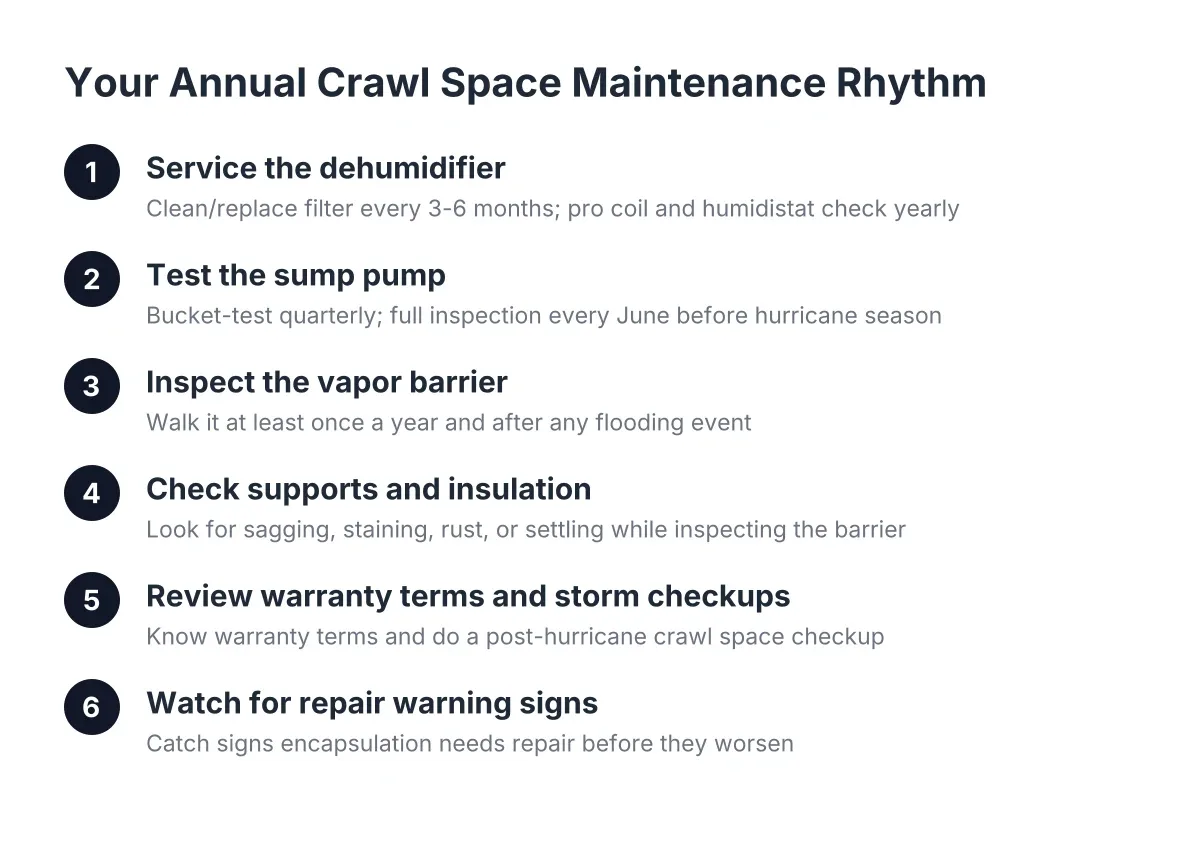
Your Maintenance Schedule: What to Service and When
Encapsulation is not a set-it-and-forget-it upgrade. Instead, think of it like an HVAC system under your house. Every component has a service interval, and skipping those intervals is how systems fail quietly. Below is the schedule we recommend for Lowcountry homes, where coastal humidity and high water tables push equipment harder than the national average.
Dehumidifier Servicing: Every Six Months
Your crawl space dehumidifier runs more hours per year in Charleston than it would almost anywhere else in the country. As a result, filters clog faster and coils collect dust and debris sooner. Plan on a filter cleaning or replacement every six months, with a full coil cleaning and drainage check once a year. Additionally, confirm the humidistat still reads accurately. A dehumidifier set to 55% that actually holds 65% is a mold problem waiting for a warm week.
Listen for changes, too. For example, a unit that cycles constantly or runs louder than it used to is telling you something. Catching a failing fan motor early costs far less than replacing a unit that burned itself out, and it's a habit that pays for itself many times over.
Sump Pump Checks: Quarterly, and Before Hurricane Season
A sump pump that fails during a June downpour defeats the entire system. Because of that, we recommend a quarterly test: pour water into the basin and watch the pump kick on, evacuate the water, and shut off cleanly. Check the discharge line for clogs or crushed sections outside the house. Beyond that, test any battery backup twice a year, since backup batteries degrade whether or not they ever run.
Timing matters here. Schedule one of those quarterly checks for late May, right before hurricane season starts. That single habit prevents more emergency calls than any other item on this list, and it costs almost nothing in time or money.
Vapor Barrier Inspection and Crawl Space Maintenance: Once a Year, Minimum
Vapor barriers fail at seams, penetrations, and traffic paths. Consequently, an annual walkthrough should check every taped seam, every pier wrap, and every spot where a plumber or cable technician may have crawled through. Small tears are cheap to patch. However, a lifted seam left alone for two years lets ground moisture back into a sealed space, and that undoes the encapsulation entirely. If you want to budget for these visits, our guide to what crawl space upkeep actually costs breaks down typical service pricing for the Charleston area.
Seasonal and Post-Storm Checkups for Crawl Space Maintenance
Maintenance schedules that work in Ohio do not work here. Charleston homes face tidal flooding, tropical systems, and a water table that sits inches below some Lowcountry lots. Therefore, your maintenance calendar needs to follow the local weather, not a generic national checklist.
Why Charleston Homes Need More Frequent Attention
The numbers back this up. Charleston set a record of 17 high-tide flood days during the 2023–24 meteorological year, according to NOAA Tides and Currents. That represents 17 days when groundwater pushed higher than normal under thousands of area homes. Moisture problems are common nationwide, too. More than 60% of U.S. homes have had water or moisture problems in their basement or crawl space, according to the American Society of Home Inspectors. In a coastal flood zone, your odds run worse than that average, not better.
Older Charleston homes add another layer of risk. Many sit on raised pier-and-beam foundations with vented crawl spaces that were designed for a different era. Even after encapsulation, those structures carry decades of moisture history in their framing. As a result, they benefit from closer monitoring than new construction, and a consistent maintenance routine matters more for these older homes than for newer builds.
The Post-Hurricane Crawl Space Checkup
After any named storm or major flooding event, get eyes under your house within a week or two. Do not wait for a smell or a warped floor. A post-storm checkup should confirm four things. First, the sump basin drained and the pump still cycles. Second, no standing water or silt sits on top of the vapor barrier. Third, the dehumidifier survived any power interruption and returned to its setpoint. Fourth, no floodwater compromised insulation or ductwork.
Storm surge and wind-driven rain find gaps that normal weather never tests. For example, a crawl space vent cover that held for five years can fail in one tropical system. To put it simply, one post-storm inspection costs a fraction of the mold remediation it prevents.
Spring and Fall Transition Checks
Between storm events, the shoulder seasons deserve attention too. In spring, rising temperatures and humidity increase the load on your dehumidifier just as pollen clogs its filter. In fall, cooling ground temperatures can shift condensation patterns along ductwork and piers. With this in mind, pair your seasonal checks with tasks you already do, like changing HVAC filters or testing smoke detectors. Consistency beats intensity when it comes to keeping a crawl space dry and stable year-round.
Protecting Your Warranty and Spotting Trouble Early
An encapsulation warranty is only as good as the service record behind it. Most encapsulation warranties, ours included, assume the system stays intact and serviced. However, many homeowners never read the maintenance terms until something fails. Do not be that homeowner.
Know Your Warranty Terms Before You Need Them
Pull out your warranty documents and look for three things. Check what the warranty actually covers, such as the liner, the dehumidifier, the sump pump, or all three. Next, check what upkeep it requires you to perform or document. Finally, check what actions void it. For instance, letting another contractor cut the vapor barrier for a plumbing repair and leaving it unsealed can jeopardize coverage on the whole system. If a trade needs access to your crawl space, tell your encapsulation company afterward so they can inspect and reseal.
Documentation matters just as much. Keep records of every service visit, filter change, and inspection. A maintenance contract handles this automatically, which is one reason recurring service plans exist. The maintenance cost guide covers what those plans typically run and what they include.
Signs Your Encapsulation Needs Repair
Between scheduled visits, watch for these signals. Musty odors returning to the living space usually mean humidity is climbing under the house. Additionally, condensation on ductwork, sweating pipes, or fog on the dehumidifier's housing points to a unit that has fallen behind. Sagging or separated liner seams, standing water on top of the barrier, and a sump pump that runs constantly all warrant a call.
Indoor air quality gives you clues, too. Roughly 15% of American homes sit on a crawl space foundation, according to JSE Labs, and air from that space moves up into the living area through the stack effect. Consequently, new allergy symptoms, persistent humidity upstairs, or a musty smell near floor vents often trace back to a problem below the floor. South Carolina homes should also stay aware of radon, since the state's average indoor radon level of about 1.9 pCi/L runs above the national average of 1.3, according to Radon.org. Testing guidance from the EPA explains how radon mitigation works, and a sealed crawl space makes that process easier if you ever need it.
That said, the biggest sign of trouble is silence. If nothing under your house has been checked in over a year, assume something needs attention. Systems rarely fail loudly. They fail slowly, and then all at once.
What a Realistic Upkeep Routine Looks Like Over a Year
Pulling the schedule together, a full year of upkeep looks something like this: two dehumidifier services, four sump pump tests timed around hurricane season, one thorough vapor barrier walkthrough, and at least one seasonal transition check in spring and fall. Add a post-storm inspection whenever a named system passes through, and you have a routine that matches how Lowcountry weather actually behaves rather than a generic checklist built for a drier climate.
None of these individual tasks takes long. However, skipping them compounds quickly, since a clogged filter, a sluggish pump, and a lifted seam rarely announce themselves until they interact with each other during a bad storm. Homeowners who stick to a written schedule, whether they track it themselves or hand it to a service provider, tend to catch small issues while they are still inexpensive to fix. That is the entire purpose behind treating crawl space upkeep as a recurring habit instead of a one-time project.
Ready to Get Started?
Your encapsulation system protected your home the day we installed it, and staying on top of crawl space maintenance keeps it protecting your home for decades. Whether you need a one-time inspection, a post-storm checkup, or a recurring maintenance plan, our Charleston-based team knows exactly what Lowcountry crawl spaces demand. Reach out and let's put your system on a schedule that keeps your warranty intact and your air dry.