DIY Crawl Space Maintenance vs. Hiring a Pro: A Charleston, SC Guide
If your crawl space is already encapsulated, you own a system, not just a space. Like a roof or an HVAC unit, that system needs upkeep. The good news for homeowners in Charleston, SC is that most of that upkeep is DIY crawl space maintenance you can handle yourself with a flashlight and an hour on a Saturday. The rest, the structural and mechanical work, belongs to a specialist. This guide draws the line between the two so you protect your investment, keep your warranty intact, and catch small problems before they turn into sagging floors and big repair bills.
That line matters more here than in most places. Charleston's year-round humidity, high water tables, and tidal flooding push crawl space systems harder than almost anywhere else in the country. According to NOAA Tides and Currents, Charleston set a record of 17 high-tide flood days during the 2023-24 meteorological year. A dehumidifier or sump pump that quietly fails in June can do a full season of damage before anyone notices.
Why Maintenance Matters After Encapsulation and Your Crawl Space Maintenance Checklist
Encapsulation is not a one-and-done fix. It is a working system: a sealed vapor barrier, a dehumidifier, often a sump pump and perimeter drainage, and sometimes structural supports. Each part has a job, and each part can fail quietly because nobody looks at it.
That quiet failure is the real risk. Most homeowners never enter their own crawl space, and even plumbers or HVAC techs who go down there usually head straight to their equipment without checking the rest of the space. Damage can sit undetected for years. More than 60% of U.S. homes have had water or moisture problems in their basement or crawl space, according to the American Society of Home Inspectors, and an encapsulated space is not immune if the system stops working.
There is also a warranty angle. Most encapsulation warranties, whatever company installed yours, expect the homeowner to keep the system running: empty or drain the dehumidifier, keep the sump pump powered, and report damage promptly. Skip the basics and you risk paying out of pocket for a failure the warranty would have covered. A simple routine of crawl space maintenance with a checklist, split between what you do and what a pro does, is the cheapest insurance you can buy for the system.
DIY Crawl Space Maintenance Tasks You Can Handle Yourself
Plenty of upkeep requires no tools beyond a flashlight, a hygrometer, and a willingness to open the crawl space door. Here is what a Charleston homeowner can safely do without calling anyone.
Check the Dehumidifier Monthly
Your crawl space dehumidifier is the heart of the system in the Lowcountry, and it works hardest from May through October. Once a month, confirm three things: it has power, it is actually running, and the humidity reading is in range. Aim for 50 to 55 percent relative humidity. A cheap digital hygrometer left on the vapor barrier gives you a number you can trust instead of a guess.
In addition, clean or replace the dehumidifier filter on the schedule in your unit's manual, usually every three to six months. A clogged filter makes the unit run longer, wear out faster, and remove less moisture. If the unit drains to a condensate pump or a gravity line, pour a cup of water into the drain pan and watch it clear. A blocked drain line is one of the most common dehumidifier failures and one of the easiest to catch early.
Test the Sump Pump Quarterly
How often should you test a crawl space sump pump? Every three months, and again before hurricane season starts in June. Testing takes five minutes: lift the sump pit lid, pour in a bucket of water, and confirm the pump kicks on, moves the water out, and shuts off. If it hums but does not pump, or cycles on and off repeatedly, it needs service.
While you are there, check the discharge line outside. The pipe should carry water well away from the foundation, not dump it right back at the stem wall where it re-enters the crawl space. For Charleston lots in flood zones, this quarterly test is the single most important item on the list. A perimeter drain and sump pump exist to intercept water coming in under the foundation, as the Building America Solution Center describes; a dead pump means that water has nowhere to go.
Walk the Vapor Barrier Twice a Year
Twice a year, crawl the space with a bright flashlight and inspect the vapor barrier itself. A proper encapsulation runs plastic across the entire floor and seals it to the stem walls and around support piers, according to the U.S. Department of Energy. You are looking for anything that breaks that seal:
- Seams that have pulled apart or tape that has let go
- Tears or punctures, often from a plumber or cable tech dragging tools across the liner
- Sections pulling away from the stem wall or sagging off piers
- Standing water or condensation on top of the liner
- New staining, white mineral deposits, or rust lines on the foundation walls
Small tears can be a DIY fix with manufacturer-approved seam tape. Anything larger, or any seam failure along the stem wall, is worth a pro visit, because a resealed wall connection is only as good as the surface prep behind it. One more Lowcountry note: some codes require a termite inspection strip near the top of the foundation wall to stay uncovered by the vapor barrier, according to Stego Industries, so do not tape plastic over that gap yourself.
Do a Post-Storm Walkthrough
After any named storm, king tide event, or hard multi-day rain, give the crawl space a quick look within a few days. Charleston's flood-prone, tidal lots mean storm water can enter a crawl space that stays dry the rest of the year. Check for standing water on the liner, confirm the sump pump ran, and sniff for that musty smell that signals trapped moisture. This post-hurricane checkup takes ten minutes and catches most storm damage while it is still minor.
Keep the Space Clean and the Door Sealed
Finally, the boring basics. Keep stored items off the vapor barrier; boxes and lumber puncture liners and block airflow. Keep the access door or hatch sealed and weather-tight, since a leaky door lets humid Charleston air pour into a space your dehumidifier is fighting to dry. Also keep gutters clean and downspouts extended, because roof water dumped at the foundation ends up under the house.
A Simple DIY Crawl Space Maintenance Schedule Checklist
To make this concrete, here is the full homeowner routine on a calendar. Print it, tape it inside the crawl space door, and check items off.
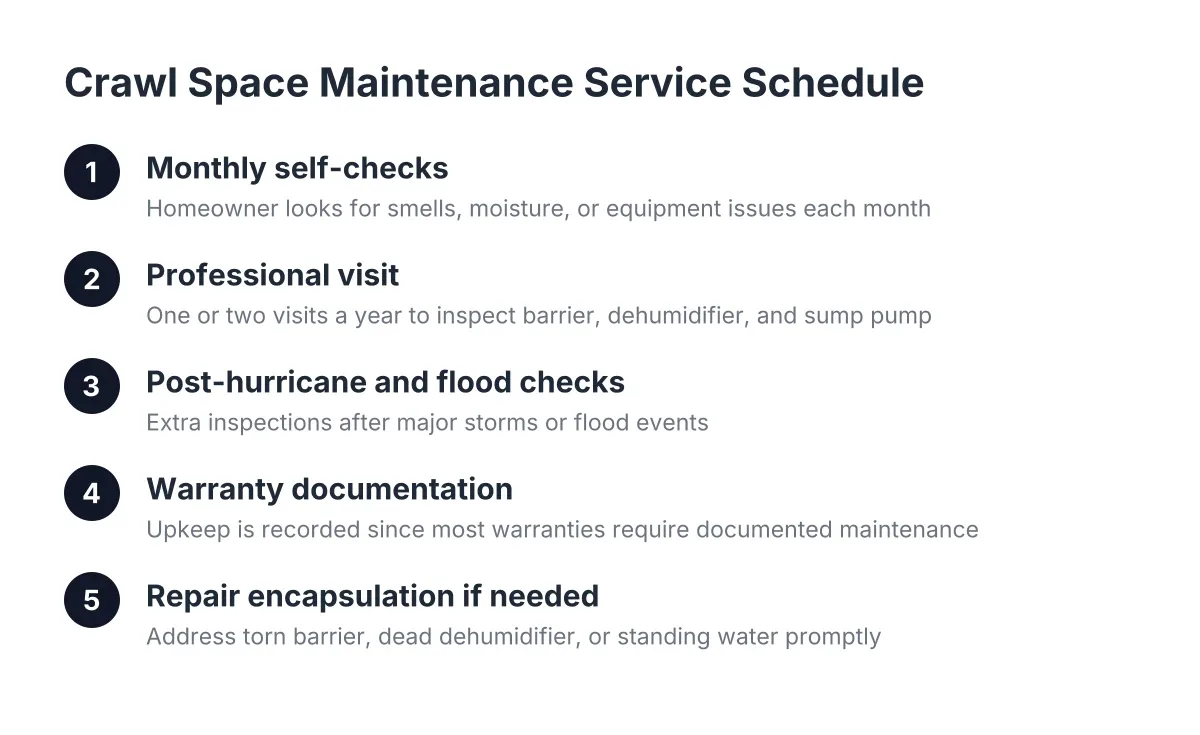
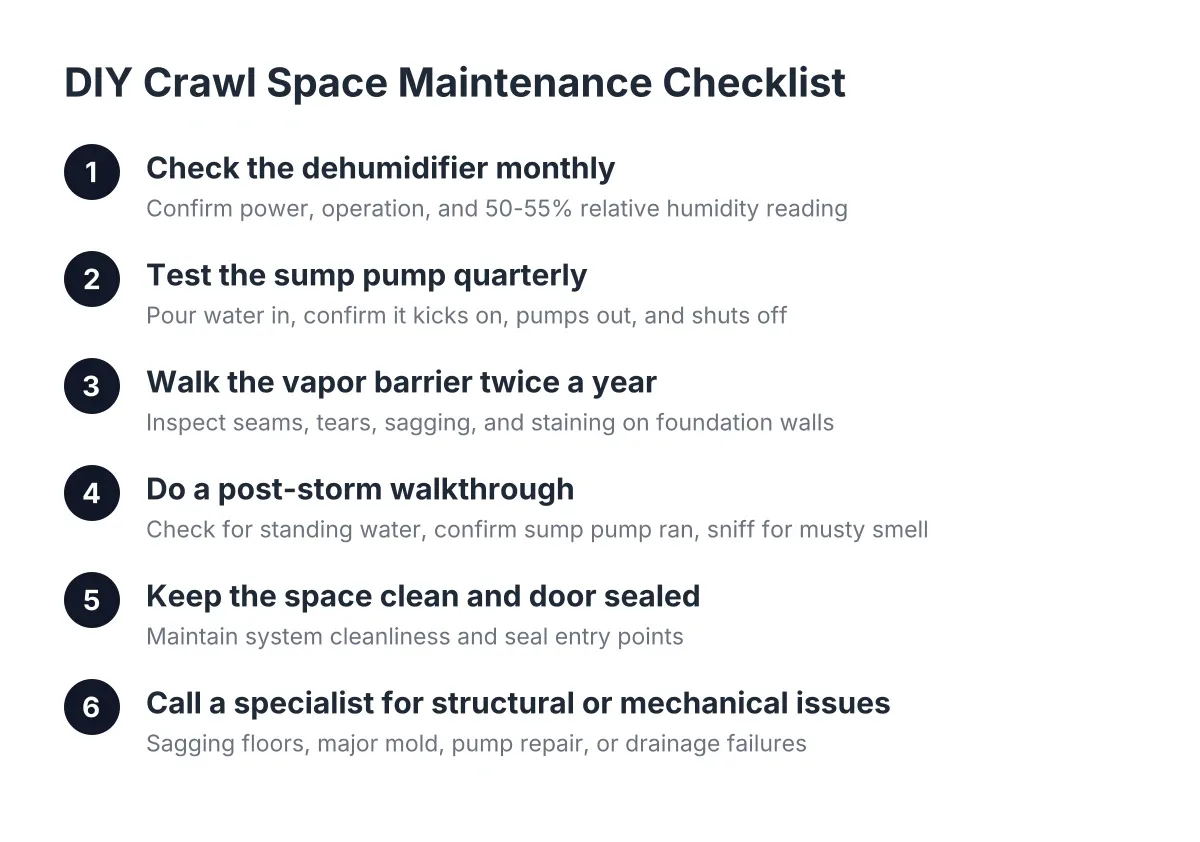
- Monthly: Verify the dehumidifier is running and humidity reads 50 to 55 percent.
- Quarterly: Test the sump pump with a bucket of water; check the discharge line outside.
- Every 3 to 6 months: Clean or replace the dehumidifier filter; flush the condensate drain.
- Twice a year (spring and fall): Crawl the full space; inspect vapor barrier seams, tape, and wall attachment; look for pests, mold, and water staining.
- Before June 1: Pre-hurricane-season check of pump, drainage, and door seal.
- After major storms or king tides: Quick walkthrough for standing water and musty smell.
- Annually: Schedule a professional inspection and system service.
The whole DIY side of this schedule costs almost nothing and takes a few hours per year. The payoff is catching a $150 problem before it becomes a $5,000 one.
When to Stop DIYing and Call a Crawl Space Specialist
Some jobs under the house are not homeowner jobs, and knowing the difference is the point of this guide. As a rule, if the work involves structure, mold remediation, electrical, or redesigning the system itself, hire a specialist.
Anything Structural: Sagging Floors, Joists, and Beams
If your hallway floor feels soft or bouncy, a door suddenly sticks, or you can see a dip in the floor line, do not try to fix it yourself and do not ignore it. Sagging floors over a crawl space usually trace back to moisture-weakened joists, a failing beam, or settled piers. Structural repair, including support jacks, sistered joists, and beam replacement, should be done by a licensed contractor. A misplaced jack can crack a beam or shift the load somewhere worse.
Suppose a homeowner in West Ashley notices a bouncy spot in the hallway and a friend says the joists might be rotting. The honest answer is that nobody can tell from upstairs. It could be one damp joist needing a sister board, a repair that often runs in the hundreds to low thousands. Or it could be a rotted main beam needing jacks and replacement, which can run well into five figures. The only way to know is a proper inspection, and a specialist can usually tell you which scenario you are in within an hour under the house. The fear of a ballooning bill is understandable, but guessing costs more than knowing.
Mold Beyond a Small Surface Spot
A musty smell that persists, visible growth spreading across joists, or dark staining on subfloor calls for professional mold remediation, not a spray bottle. Professional mold removal is more thorough than a DIY chemical treatment and does a better job preventing regrowth, because the pro also finds and fixes the moisture source feeding it. Spraying mold while the humidity problem continues is painting over rust.
Dehumidifier and Sump Pump Repair or Replacement
You maintain these; a pro repairs them. Commercial crawl space dehumidifiers are hardwired or on dedicated circuits, and sump pumps involve pits, check valves, and discharge plumbing. If your quarterly test fails or the dehumidifier cannot hold 55 percent humidity even with a clean filter, book a service call rather than swapping parts yourself.
Drainage, Grading, and Encapsulation Repairs
Water pooling on top of the liner after rain usually means a drainage problem under it, and that is below the DIY line. Proper systems involve grading the crawl space floor to slope toward a perimeter drain, gravel beneath the barrier, and piping routed to the sump pump, per the Building America Solution Center. Getting that geometry wrong just moves the puddle. The same goes for insulation in a conditioned crawl space, which belongs on the stem walls and rim joists rather than between the floor joists; DIY crawl space insulation stapled up into the floor of an encapsulated space fights the system instead of helping it.
Why Full DIY Crawl Space Repair Rarely Pays Off in Charleston
Could a determined homeowner encapsulate or re-encapsulate a crawl space alone? Technically yes, and plenty of DIY crawl space repair videos suggest it is a weekend project. In practice, it is a large, exhausting job that most pros, and most homeowners who have tried it, recommend hiring out.
Consider what the job actually involves. You are working in three to four feet of clearance, on your knees or your back, for many hours, in a Charleston crawl space that may be 85 degrees and 90 percent humidity half the year. The materials matter too: true encapsulation liner, seam tape, wall fasteners, and sealants are not stocked at the typical home center, so you end up ordering from specialty suppliers and hoping you measured right. Mis-measure the stem wall height or the pier count and you stall the project mid-crawl.
There is also the knowledge gap. About 15% of American homes sit on a crawl space foundation, according to JSE Labs, but every one is different, and Charleston's raised pier-and-beam homes with high water tables are their own category. A pro's detailed inspection and accurate measurements up front prevent the delays and callbacks that sink DIY attempts. For the maintenance tasks in this guide, DIY is the right call. For installation, remediation, and structural work, the math favors the specialist, especially when a sale deadline is involved.
The Annual Professional Inspection: What It Covers and What It Costs
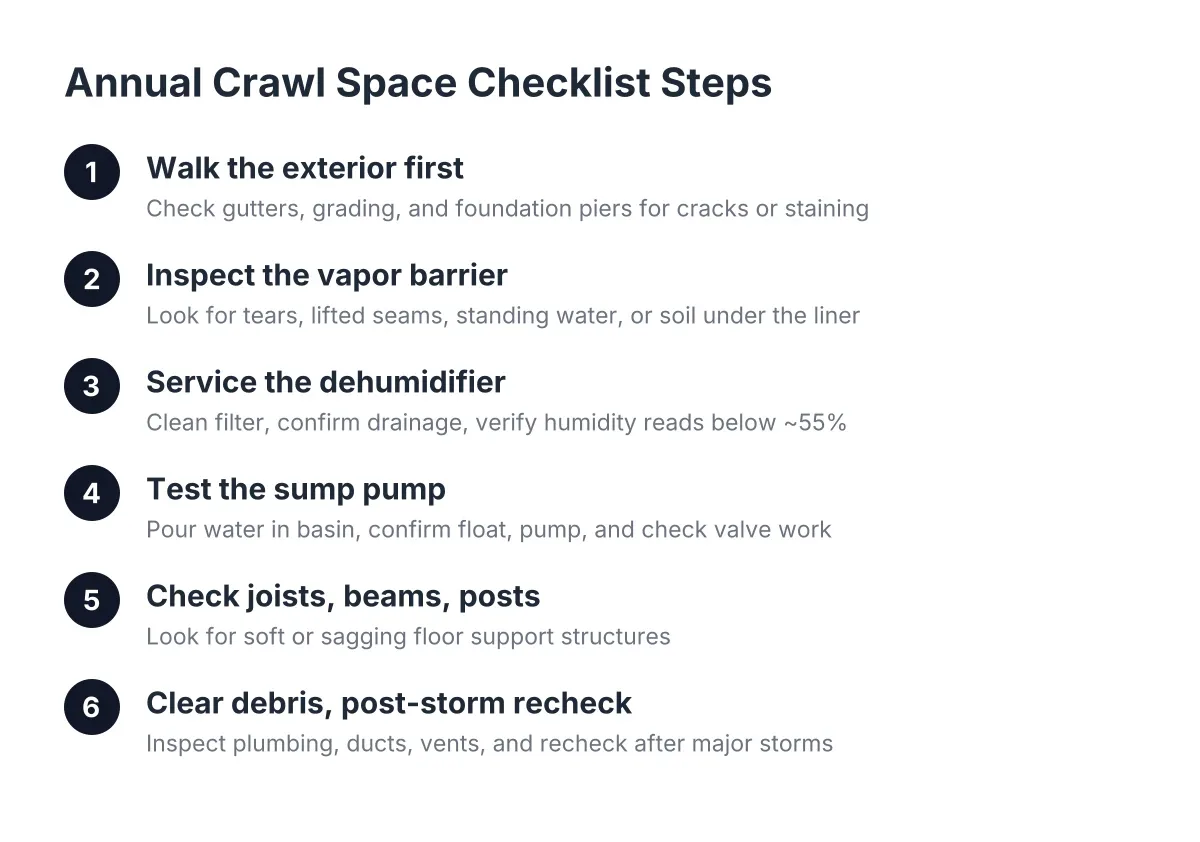
An annual professional crawl space inspection is the one recurring service worth paying for even when everything seems fine. It typically covers the things a homeowner cannot judge: moisture readings inside joists and beams, early rot or pest damage, dehumidifier performance under load, pump and drain function, liner seal integrity at every wall and pier, and any early signs of settlement or sagging.
As a rough illustrative range in 2026, expect a standalone inspection to run from free (when offered as part of an estimate) to a couple hundred dollars, with an annual service visit that includes dehumidifier servicing and minor liner repairs often landing in the $150 to $400 range. Those are ballpark figures, not quotes; your home's size and system complexity move the number. Compare that to typical repair costs when neglect catches up: mold remediation often runs $1,500 to $5,000, and structural work with jacks and beam repair can run $3,000 to $10,000 or more.
This matters double if you are selling. Say a seller in Mount Pleasant has a closing date six weeks out and the buyer's inspector flags crawl space moisture and a torn vapor barrier. In that scenario, documentation from an annual maintenance relationship, service records, humidity logs, and a current inspection report can keep a flagged item from becoming a renegotiated price. Buyers and their agents trust paper, and a maintained system with records sells better than a mystery under the house. A specialist who maintains systems year after year, rather than installing and disappearing, is also the one who can turn around a pre-sale repair letter on a closing timeline.
Where to Draw the Line: A Quick Decision Guide
When you find something during your DIY crawl space maintenance rounds, use this split to decide your next move.
Handle it yourself:
- Humidity checks, filter cleaning, and dehumidifier monitoring
- Quarterly sump pump bucket tests
- Taping a small, clean puncture in the vapor barrier
- Clearing debris, sealing the access door, and extending downspouts
- Post-storm visual walkthroughs
Call a specialist:
- Soft, bouncy, or visibly sagging floors; sticking doors or windows
- Visible mold growth or a musty smell that will not clear
- Standing water, a failed sump pump, or water pooling on the liner
- Liner seams failing at the stem wall, or damage larger than a hand-sized patch
- A dehumidifier that cannot hold 55 percent humidity
- Any pre-sale inspection finding with a closing date attached
One honest caveat: this guide assumes your encapsulation was installed correctly in the first place. If your system never held humidity, floods every rain, or the liner was just loose plastic laid on the dirt, maintenance will not fix a bad install. In that case, start with a professional inspection and get a straight answer about whether you have a maintenance problem or an installation problem. Either way, the floor over your head, and the deal on your closing table, are worth knowing for sure.
If you need crawl space encapsulation, Low Country Crawl Space Repair can help.
Prefer to talk it through? Call +18542013678 — a quick call is usually the fastest way to get a straight answer for your situation.