Crawl Space Vapor Barrier — Complete Guide
A crawl space vapor barrier is the single most important moisture defense under your Charleston home. This guide explains what a crawl space vapor barrier actually does, which materials and thicknesses hold up in Lowcountry humidity, and how to tell whether your current barrier is protecting your home or quietly failing. You'll learn why cheap 6-mil plastic sheets fall apart within a few years here, what separates a proper installation from a plastic-sheet fix, and how a vapor barrier compares to full encapsulation. If you own a raised pier-and-beam home on the peninsula, this is the material-level knowledge you need before hiring anyone to crawl under your house.
What You'll Find in This Guide
Why Your Charleston Home Needs a Crawl Space Vapor Barrier
Every crawl space in the Lowcountry sits over damp ground. Soil releases water vapor constantly, rising into your subfloor, framing, and living space. A vapor barrier stops that migration at the source—a heavy polyethylene sheet fitted to the dirt floor, sealed at seams, and fastened to foundation walls so ground moisture can't evaporate upward.
Charleston makes this job harder than almost anywhere else in the country. The water table sits close to the surface, so soil under older homes rarely dries out. Tidal flooding also pushes moisture up through low-lying lots regularly. According to NOAA Tides and Currents, Charleston recorded 17 high-tide flood days during 2023-24. That water saturates the ground under homes south of Broad, in Harleston Village, and across historic districts.
Older Charleston homes compound the problem. Most were built with vented crawl spaces on brick piers—a design that made sense before air conditioning. Those vents now pull humid outside air under the house all summer. Warm air hits cooler framing and condenses, adding a second moisture source on top of ground vapor. Without a barrier, you get musty smells, cupping hardwood floors, mold on joists, and rusting ductwork.
This problem is common. More than 60% of U.S. homes have had water or moisture problems in their basement or crawl space, according to the American Society of Home Inspectors. In Charleston, that percentage runs even higher because the climate never gives the ground a chance to dry. A properly installed barrier cuts off ground moisture permanently and forms the foundation of every other moisture-control measure under your home. Our crawl space vapor barrier installation page explains the full process.
Vapor Barrier Materials and Thickness: What Actually Holds Up
Walk into any big-box store and you'll find rolls of 6-mil plastic sheeting marketed as vapor barrier material. To put it simply, that product fails in Charleston. Understanding why comes down to material science, not marketing.
Why Mil Thickness Matters
A "mil" is one thousandth of an inch. Standard 6-mil polyethylene is thin enough to tear on the oyster shell, brick rubble, and construction debris common under historic Charleston homes. Crawl space technicians, plumbers, and HVAC installers will crawl across that barrier for years. As a result, thin plastic develops punctures and tears that let ground vapor right back into the crawl space. A torn barrier performs almost as badly as no barrier at all.
For real crawl spaces, professionals use 10-mil to 20-mil reinforced barriers. The best products sandwich a polyester cord scrim between layers of polyethylene, which gives the sheet tear resistance rather than just thickness. In practice, a 12-mil reinforced barrier outperforms a 20-mil unreinforced one, because reinforcement stops small punctures from spreading into long rips.
What to Look For Beyond Thickness
Thickness is only part of the spec sheet. You should also look at permeance, which measures how much water vapor passes through the material itself. Quality crawl space barriers carry a perm rating below 0.1, which classifies them as true vapor retarders. Cheap plastic often lacks any published perm rating at all.
Beyond that, look for antimicrobial treatment and UV stabilization. Antimicrobial additives stop mold from growing on the barrier surface when condensation forms. UV stabilizers matter less underground, but they signal a product engineered for longevity rather than one repackaged from general construction film.
For the Lowcountry specifically, durability against standing water matters most. Hurricane-season storms and king tides can push water under peninsula homes. A reinforced barrier with sealed seams survives that cycle, while a stapled sheet of 6-mil plastic floats, shifts, and tears. This is why our Charleston vapor barrier installations use heavy sheeting fitted and sealed to handle exactly these conditions.
Installation Quality: What Separates a Real Job From a Plastic Sheet Fix
The material matters, but installation matters more. For example, a premium 20-mil barrier laid loosely over the dirt with unsealed seams will fail. Meanwhile, a well-installed 12-mil barrier can protect a home for decades. Here's what a proper crawl space vapor barrier installation looks like, and how to spot corners being cut.
Seams, Tape, and Wall Attachment
Seams are where most vapor barrier jobs fail. Ground vapor finds every gap, so professionals overlap sheets by at least 6 to 12 inches and seal every seam with vapor barrier tape rated for the material. Ordinary duct tape loses adhesion in humid crawl spaces within months. However, purpose-made seam tape bonds permanently to polyethylene and keeps the barrier acting as one continuous membrane.
Wall attachment matters just as much. A proper installation runs the barrier up the foundation walls and piers, then mechanically fastens and seals it there. This detail is critical in Charleston, because moisture wicks up through old brick piers and foundation walls. A barrier that stops at the wall edge leaves that pathway wide open. Additionally, installers should seal the barrier around every pier, plumbing penetration, and support column, not just cut rough holes and move on.
Before any barrier goes down, the crawl space needs prep work. That means removing old plastic, fallen insulation, construction debris, and any sharp material that could puncture the new membrane. Skipping cleanup is the most common shortcut in cheap installations, and it's often invisible until the barrier fails years later.
DIY vs Professional Installation
Homeowners ask about DIY installs often, and the honest answer depends on your crawl space. A dry, accessible crawl space with 3 feet of clearance is a hard but doable weekend project. That said, most historic Charleston crawl spaces offer 18 to 24 inches of clearance, active moisture, old debris, and sometimes mold or standing water. In those conditions, DIY installs almost always end up with gaps at piers, unsealed seams, and torn sections you'll never see again once you crawl out.
Professional installation costs more upfront, typically running from a few thousand dollars depending on square footage, moisture conditions, and prep work required. In exchange, you get proper materials, sealed seams, wall attachment, and a warranty. Because a failed barrier lets rot and mold develop unseen for years, the cost of doing it wrong usually exceeds the cost of doing it right.
It's also worth considering how a barrier fits into your broader maintenance plan. A vapor barrier isn't a one-time purchase you forget about. Instead, think of it as infrastructure you should check periodically, especially after storm season, to confirm seams are intact and no new tears have appeared near ductwork or plumbing access points.
Vapor Barrier vs Full Encapsulation: How Far Should You Go?
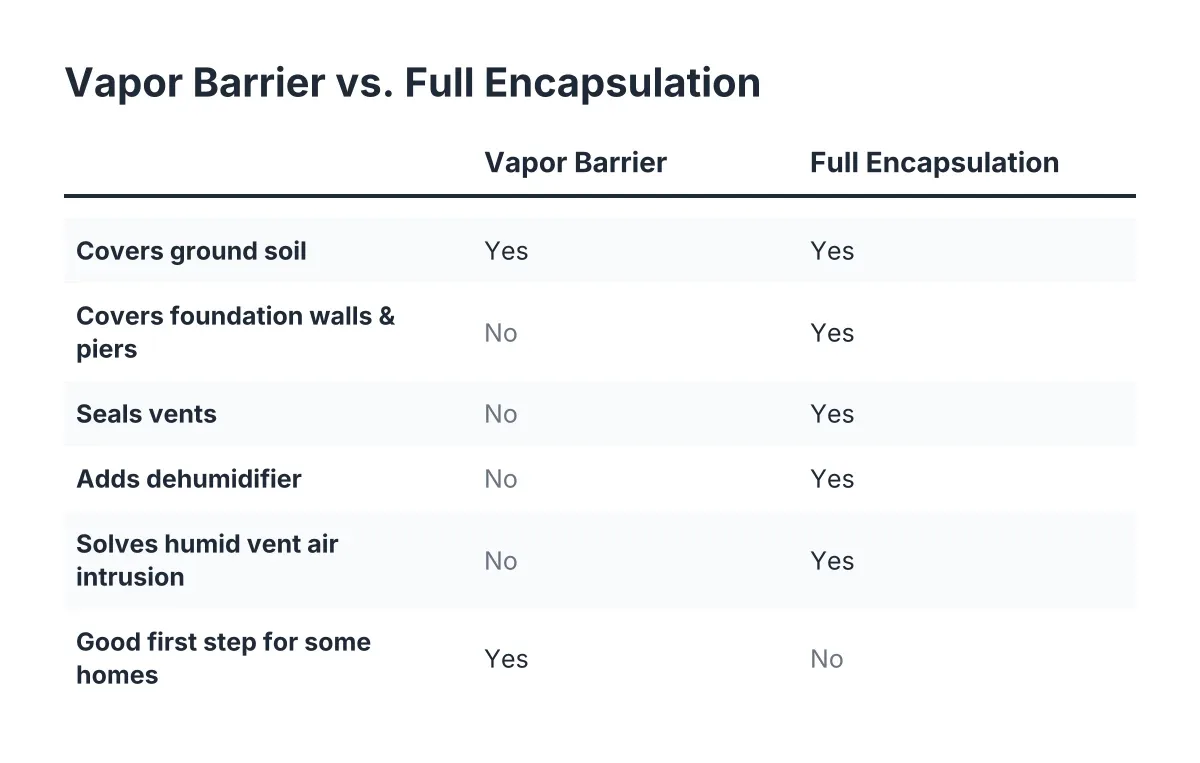
A standalone vapor barrier and full encapsulation sit on the same spectrum, and understanding the difference helps you buy the right solution for your home.
A vapor barrier alone covers the ground and blocks soil moisture. Encapsulation goes further. It seals the entire crawl space as a system: barrier on the floor and walls, sealed vents, sealed rim joists, and usually a dehumidifier to control the air itself. In other words, a vapor barrier addresses one moisture source, while encapsulation addresses all of them.
When a Vapor Barrier Alone Makes Sense
For some homes, a quality vapor barrier delivers most of the benefit at a fraction of the cost. If your crawl space stays relatively dry, your humidity problems are mild, and your main issue is ground vapor, a properly installed barrier may be enough. Historic homes with well-functioning vents and good site drainage sometimes fall into this category. About 15% of American homes have a crawl space foundation, according to JSE Labs, and plenty of them run fine with a ground barrier alone in drier climates.
When Charleston Homes Need More
Charleston is not a drier climate. Our vented crawl spaces pull in humid air from March through October, and that air condenses on cool surfaces regardless of what covers the ground. Consequently, many peninsula homes need the full system: barrier, sealed vents, and dehumidification. The U.S. Department of Energy's guidance on crawl space moisture control reflects the same shift, favoring sealed, conditioned crawl spaces over vented ones in humid climates.
There's an air quality dimension too. Roughly half the air on your first floor rises from the crawl space below it. A sealed crawl space vapor barrier also reduces soil gas entry, which matters because the average indoor radon level in South Carolina is about 1.9 pCi/L, above the national average of 1.3 pCi/L, according to Radon.org. A continuous, sealed membrane helps on both fronts, cutting off moisture and limiting how much soil gas reaches your living space.
The practical path is a professional inspection first. An inspector can measure moisture levels, check your framing, and tell you honestly whether a vapor barrier installation solves your problem or whether your home needs the full encapsulation approach. Signs your existing barrier has failed include visible tears, plastic pulled away from piers, standing water on top of the sheeting, and musty smells returning after a previous install. If you notice any of these signs, treat them as an early warning rather than a cosmetic issue, since the moisture behind them keeps working on your framing whether you can see it or not.
Ready to Get Started?
If your Charleston home has a bare dirt crawl space, a torn old barrier, or a musty smell you can't trace, the fix starts under the floor. Low Country Crawl Space Repair inspects, installs, and seals vapor barriers built for Lowcountry humidity, high water tables, and hurricane-season moisture. Schedule a crawl space inspection and find out exactly what's happening under your home before it reaches your floors.