How Long Crawl Space Encapsulation Materials Last in Charleston’s Coastal Humidity
If you are comparing contractor quotes, the crawl space encapsulation material each one proposes matters more than the bottom-line price. Two proposals can look identical on paper, "encapsulate crawl space, install dehumidifier," and differ by thousands of dollars. The difference usually hides in the materials: the thickness of the vapor barrier, the type of seam tape, the insulation on the walls, and the quality of the dehumidifier. In Charleston's coastal humidity, those choices decide whether your encapsulation lasts two decades or fails in five years, and the vapor barrier lifespan is often the decisive factor.
This guide walks through every major component of an encapsulation system, what it is made of, how long it should last in a Lowcountry crawl space, and what shortcuts to watch for in a quote. By the end, you should be able to read a proposal line by line and know what you are actually buying.
Why Charleston Is Hard on Crawl Space Encapsulation Materials
Charleston punishes crawl space materials harder than almost any inland market. The reasons stack on top of each other.
First, the humidity never takes a season off. Vented crawl spaces under older pier-and-beam homes pull in damp outside air most of the year. That air condenses on cool surfaces, feeds mold on floor joists, and leaves ductwork sweating. Any material you put down there has to survive constant moisture load, not an occasional wet month.
Second, the water table sits high and the tides push it higher. Charleston set a record of 17 high-tide flood days during the 2023-24 meteorological year, according to NOAA Tides and Currents. On flood-zone and tidal lots, groundwater can rise under a crawl space even when it never rains. A thin vapor barrier laid loose on that soil gets pushed around, punctured, and undermined.
Third, hurricane season brings moisture cycles that stress every seam and fastener. Materials expand, contract, and get soaked, then dry, then get soaked again. Tape that holds fine in a dry Midwest crawl space can let go here within a few seasons.
This is not a rare problem. More than 60 percent of U.S. homes have had water or moisture problems in their basement or crawl space, according to the American Society of Home Inspectors. In the Lowcountry, the question is less whether moisture shows up and more whether your materials are built to handle it.
The Vapor Barrier: How Its Lifespan Determines Your System's Durability
The vapor barrier is the backbone of the whole system, and it is where contractors cut corners most often. Real encapsulation means running plastic sheeting across the entire crawl space floor and sealing it to the stem walls and around support piers, according to the U.S. Department of Energy. Loose plastic thrown on the dirt is a ground cover, not encapsulation. Understanding vapor barrier lifespan is essential because that timeline directly controls how much the rest of your encapsulation investment will hold up.
What separates a 6-mil liner from a 20-mil liner
Vapor barrier thickness is measured in mils, thousandths of an inch. The difference in durability is dramatic, and it affects the vapor barrier lifespan you can expect from your project.
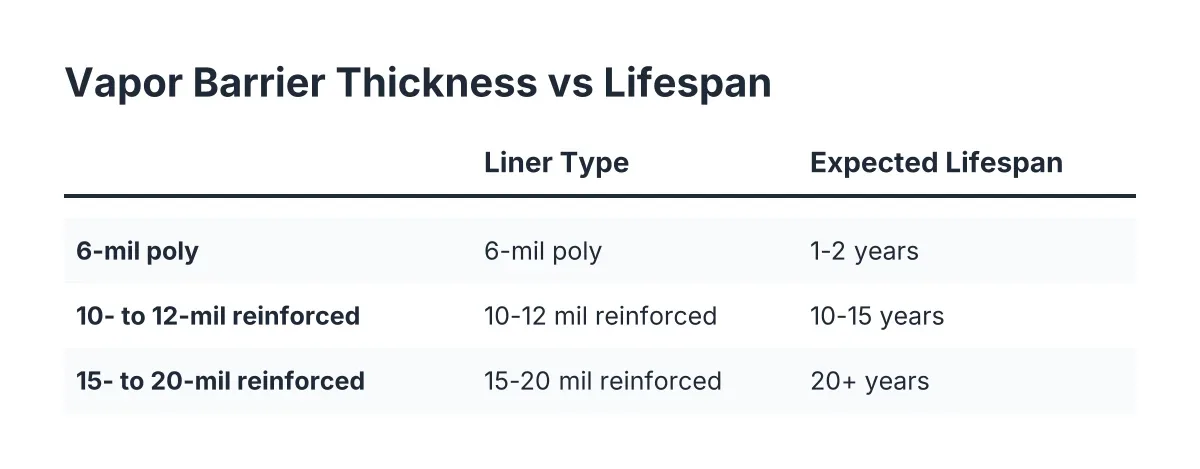
- 6-mil poly: Standard construction plastic. It tears on roots, rocks, and knees. In a crawl space that gets crawled through for HVAC or plumbing work, expect punctures within a year or two. It is the material behind most failed "encapsulations."
- 10- to 12-mil reinforced liner: The realistic minimum for a Charleston encapsulation. Reinforcement cord inside the sheet resists tearing. On a clean, graded floor, it can last 10 to 15 years.
- 15- to 20-mil reinforced liner: Heavy-duty crawl space encapsulation fabric made specifically for this job. It handles foot traffic, equipment, and shifting soil, and routinely lasts 20 years or more when seams are sealed properly.
A quote that says only "install vapor barrier" with no mil rating is a red flag. Ask. The cost of a crawl space vapor barrier is driven mostly by that number and by how far the liner runs up the walls, so you cannot compare proposals without it.
One more detail from the field: encapsulations often layer new material over an old ground barrier rather than removing it. An old 6-mil sheet left in place under a new reinforced liner adds a sacrificial layer against sharp soil. That is legitimate practice, but the quote should still specify the thickness of the new top liner.
Seams, tape, and sealants: the quiet failure points
Liners rarely fail in the middle of a sheet. They fail at seams, piers, and wall terminations. Quality systems use specialized seam tape made for crawl space liners, not duct tape or general-purpose house wrap tape. In Charleston humidity, cheap adhesive lets go, seams peel open, and ground moisture bypasses the barrier.
Wall attachment matters just as much. Look for mechanical fasteners plus a butyl or polyurethane sealant where the liner meets the stem wall. In addition, every pier should be individually wrapped and sealed. If a proposal does not mention pier wraps, the installer is planning to cut around them, and each gap is a moisture leak.
One code note: some states require a termite inspection strip near the top of the foundation wall to be left uncovered by the vapor barrier, according to Stego Industries. A contractor who knows Lowcountry work will leave that strip and explain why. A contractor who runs the liner to the sill plate either does not know local practice or does not care.
Comparing Crawl Space Encapsulation Materials Line by Line
Once you understand the liner, the rest of the system is easier to evaluate. A complete quote in 2026 should account for most of these components. Missing items are not savings; they are gaps you will pay for later.
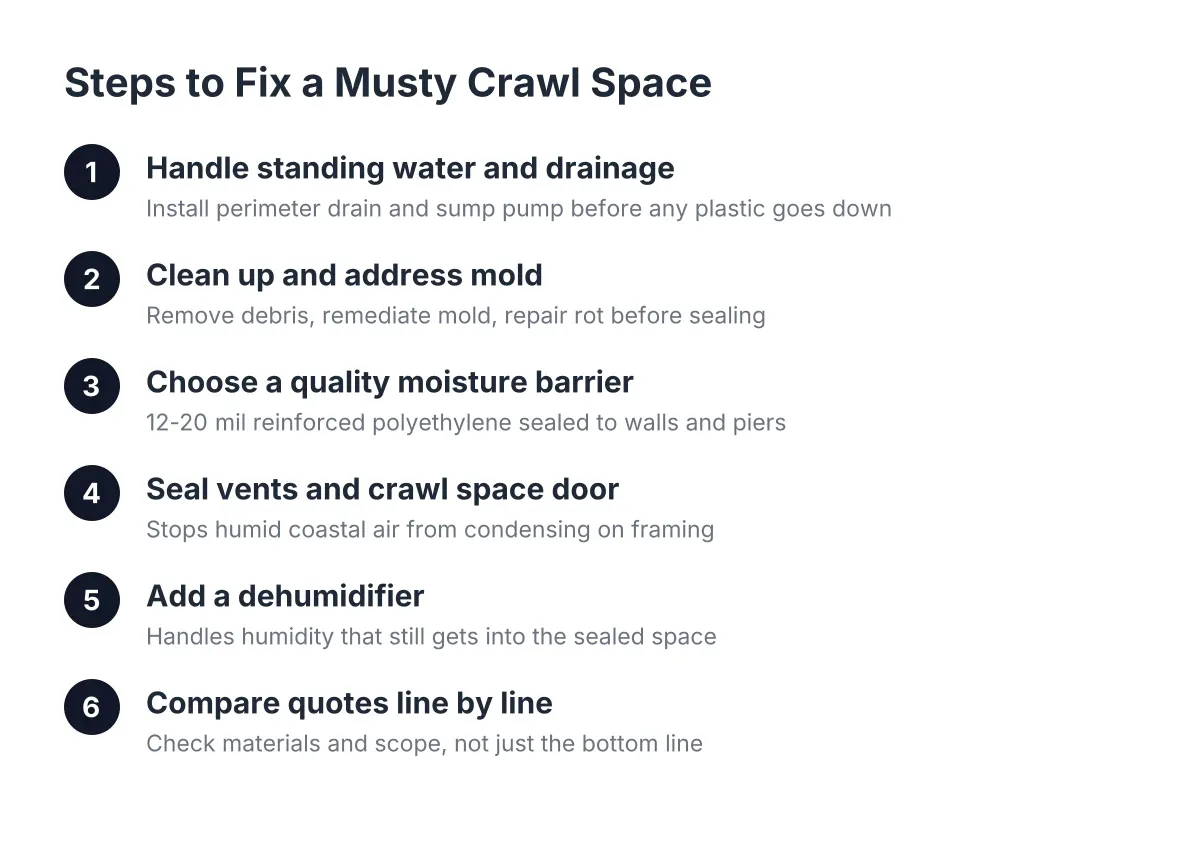
- Cleanup and prep. Debris removal, grading the dirt, and dropping or layering the old barrier. Grading and leveling the soil so it slopes slightly toward a drain helps water flow to the perimeter drain and sump pump instead of pooling in the middle, according to the Building America Solution Center.
- Mold remediation, if flagged. If an inspection report mentions evidence of mold, the sequence matters: clean and treat the wood first, then encapsulate. Sealing mold under a new liner does not remove it.
- Drainage. Encapsulated floors are often built up with several inches of gravel beneath the vapor barrier, with drainage piping around the foundation perimeter, according to the Building America Solution Center. On a high-water-table lot, this layer is not optional.
- Sump pump. A sealed crawl space traps water like a pool if a pipe bursts or floodwater enters, so a sump pump at the low point acts as the emergency eject, per the Building America Solution Center. Cast-iron pumps with sealed basins outlast plastic bargain units.
- Vapor barrier and seam system. Mil rating, reinforcement, wall height, pier wraps, tape, and sealant, as covered above.
- Vent sealing. Foam or rigid vent covers sealed airtight, plus a sealed, insulated access door.
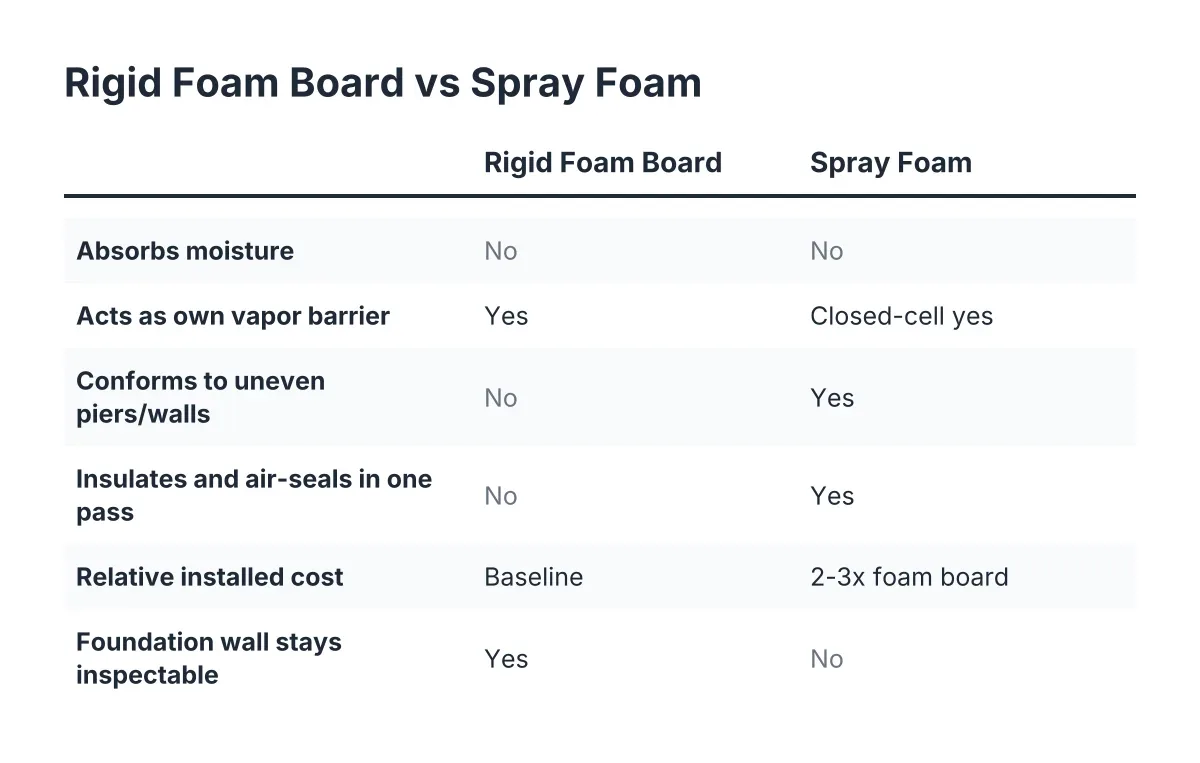
- Insulation. Rigid foam or closed cell spray foam on the stem walls and rim joists.
- Dehumidifier. A crawl-space-rated unit with a condensate pump or gravity drain, not a portable box-store model.
When you compare the cost of crawl space encapsulation per square foot across bids, line the proposals up against this list. A bid that is 30 percent cheaper usually dropped the drainage, downgraded the liner, or skipped the dehumidifier. In Charleston, each of those omissions shortens the life of everything else.
Sealed Vents and Insulation: Materials That Control the Air
Sealing the vents is where encapsulation departs from the old Lowcountry habit of ventilating crawl spaces. The logic of vented crawl spaces assumed outside air would dry things out. In coastal humidity, the opposite happens; vents feed damp air to cool surfaces and create condensation. Sealing them removes the moisture source, as long as a dehumidifier takes over the drying job.
Vent covers and access doors
Quality vent covers are rigid, gasketed, and sealed with foam or sealant, not a plastic plate screwed loosely over the opening. Foam plugs behind the cover add insulation value. The crawl space door gets the same treatment: sealed, weatherstripped, and insulated. A perfectly sealed liner means little if hurricane-season air pours in around a warped plywood hatch.
Wall insulation that survives the damp
In a conditioned, sealed crawl space, insulation belongs on the exterior stem walls and rim joists rather than in the floor between joists, according to the Building America Solution Center. That placement brings the crawl space inside the home's thermal envelope.
Material choice matters for lifespan. Fiberglass batts stuffed between floor joists absorb moisture, sag, and fall within a few humid years; they are the most common failed insulation in Charleston crawl spaces. By contrast, taped rigid foam board on the stem walls and rim joists, sealed at the rim joist with expanding foam or fluid-applied sealant, holds its R-value and does not absorb water, per the Building America Solution Center. Closed cell spray foam performs similarly and adds air sealing, at a higher price.
Therefore, if a quote lists "insulation" without saying what kind and where, ask. Fiberglass in the joists is a 1990s approach being sold at 2026 prices.
The Dehumidifier: The Material Choice You Will Live With Longest
A sealed crawl space without active dehumidification is an unfinished job in this climate. Once the vents are closed, the dehumidifier is the only thing managing humidity between the liner and your floor joists.
Crawl-space-rated dehumidifiers differ from the portable units sold for bedrooms. They are built low-profile for the space, rated to run continuously, and drain automatically through a condensate pump or gravity line so no one has to empty a bucket under the house. A quality unit paired with a sealed liner typically keeps relative humidity below the mold-growth threshold year-round.
However, this is also the component that needs ongoing attention. Filters clog, condensate lines grow algae, and pumps wear. Homeowners who already have an encapsulated crawl space learn this on a schedule: an annual or storm-season check, a filter change, and a sump pump test. Budgeting a few hundred dollars a year for that maintenance protects a system that cost thousands to install. Materials determine how long the system can last; maintenance determines whether it actually does.
There is a side benefit to the full sealed assembly worth knowing. A sealed ground barrier also blocks soil gas from entering the home, which matters here because the average indoor radon level in South Carolina is about 1.9 pCi/L, above the national average of 1.3, according to Radon.org. Encapsulation is not a radon system, but a continuous sealed liner is the foundation one would build on.
Reading a Quote Under Deadline: A Pre-Sale Scenario
Suppose a homeowner in West Ashley gets her inspection report back two weeks before closing. It flags moisture intrusion and evidence of mold in the crawl space, the buyer's agent wants documentation, and her realtor calls daily. She collects three bids. One says "vapor barrier and mold treatment" for a low price. Another lists a 15-mil reinforced liner, sealed seams, pier wraps, vent sealing, antimicrobial treatment of the joists, and a crawl-space-rated dehumidifier, for more.
In that scenario, the materials list is her protection, not an upsell. The cheap bid might pass a glance, but the buyer's inspector will crawl back under that house before closing. Thin plastic laid loose, open vents, and untreated joists read as a patch job and invite a price renegotiation. A documented scope with named materials, mil ratings, and photos gives the buyer's agent something solid, and it gives the next owner a system that still works in year ten.
Not every flagged crawl space needs full encapsulation to close a sale; sometimes targeted mold remediation and a proper ground barrier satisfy the buyer's request. That judgment call depends on the inspection findings, the lot, and the water table, and it is worth a professional crawl space inspection rather than a guess. A standing-water problem, sagging floors, or structural concerns around beams and piers also need drainage or structural support addressed first, because no liner fixes a foundation issue.
A Materials Checklist for Comparing Bids
Before you sign anything, confirm the proposal answers these questions in writing:
- What mil thickness is the liner, and is it reinforced crawl space encapsulation fabric or generic poly?
- How high does the liner run up the stem walls, and is a termite inspection strip left per local code?
- Are piers individually wrapped and sealed?
- What seam tape and wall sealant are specified?
- Is the soil graded, and is there gravel, perimeter drainage, or a sump pump for this lot's water table?
- Are vents sealed with rigid, gasketed covers, and is the access door sealed and insulated?
- What insulation goes on the stem walls and rim joists, and what is its R-value?
- Is the dehumidifier crawl-space-rated with an automatic drain, and what maintenance does it need?
- If mold was flagged, is cleaning and antimicrobial treatment included before the new liner goes down?
About 15 percent of American homes sit on a crawl space foundation, according to JSE Labs, but in older Charleston neighborhoods the share runs far higher, and those crawl spaces face conditions most of the country never sees. The materials under your house are either rated for that environment or they are not. Read the list, ask for the mil ratings and product names, and compare bids on substance. In this climate, the cheapest crawl space encapsulation materials are almost always the ones you end up buying twice.
If you need crawl space encapsulation, Low Country Crawl Space Repair can help.
Prefer to talk it through? Call +18542013678 — a quick call is usually the fastest way to get a straight answer for your situation.