Crawl Space Foundation Repair Cost Breakdown for Charleston Homes
If your inspection report just came back flagging moisture, mold, or a sagging beam under the house, you need two things fast: a clear idea of what crawl space repair costs, and a paper trail that satisfies a nervous buyer. This guide breaks the cost down the way a good contractor's quote should, by labor, materials, and scope. It also covers what makes Charleston pier-and-beam homes different, because a repair plan built for a slab house in the suburbs will not hold up under a 120-year-old raised home two blocks from the harbor.
The short version: moisture damage in a Charleston crawl space usually falls into a few repair categories, and each one carries a different price band. Knowing which category your house falls into is the single biggest factor in what you will pay and how fast the work can be done.
Why Moisture Drives Foundation Damage Under Charleston Homes
Charleston crawl spaces work harder than crawl spaces almost anywhere else. The air is humid most of the year, the water table sits high, and many lots sit in or near flood zones. During the 2023-24 meteorological year, Charleston set a record of 17 high-tide flood days, according to NOAA Tides and Currents. That water does not stay in the street. It raises soil moisture under homes across the peninsula and the surrounding communities.
Older Charleston homes make the problem more visible. Most were built on pier-and-beam foundations with vented crawl spaces. Brick piers hold wood beams, and wood joists carry the floor. Those open foundation vents were supposed to dry the space out. In practice, they pull humid coastal air under the house, where it condenses on cool wood and masonry.
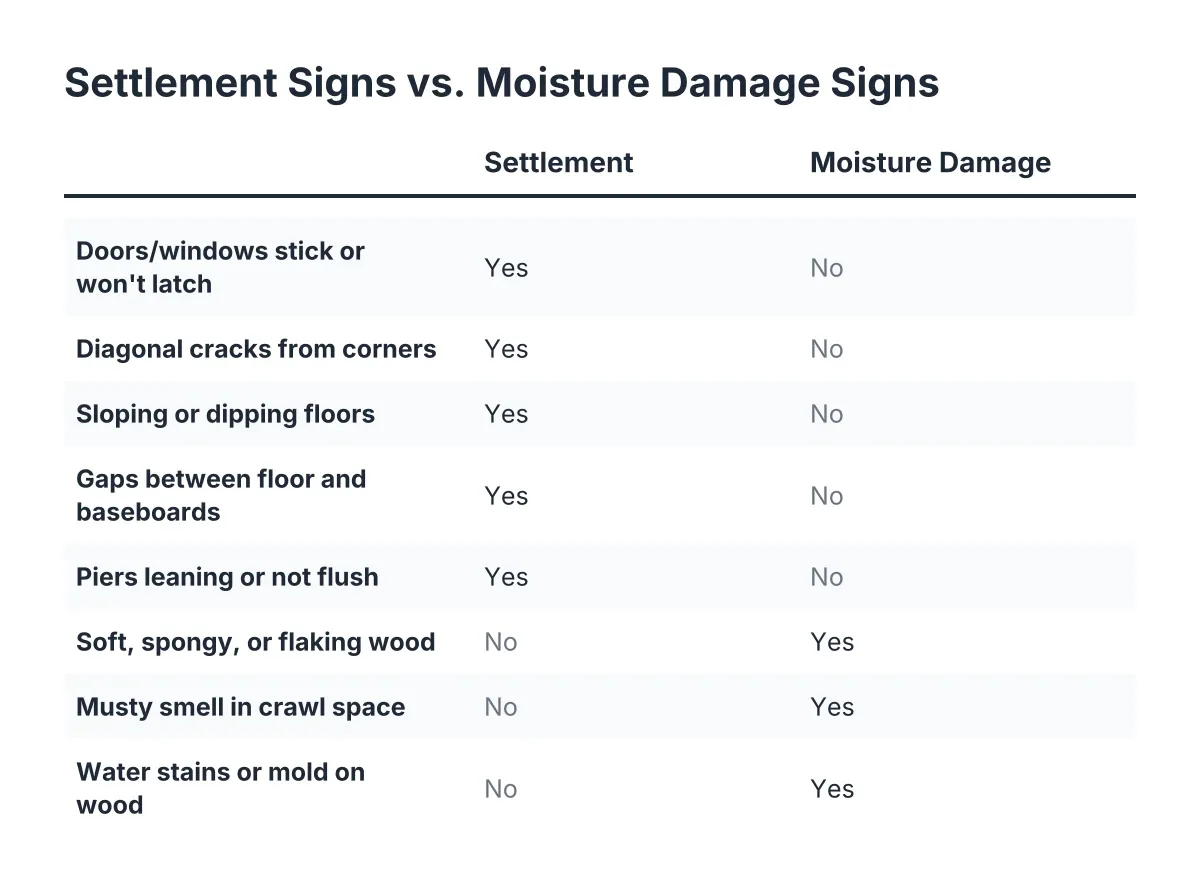
Over time, that moisture does three kinds of damage. It rots beams, joists, and sills. It softens the soil under piers, which lets them settle or lean. And it feeds mold on the wood framing, which is the line item that spooks buyers on inspection reports. This is not rare. More than 60 percent of U.S. homes have had water or moisture problems in their basement or crawl space, according to the American Society of Home Inspectors. In the Lowcountry, the percentage of crawl spaces showing some moisture damage is a safe bet to be higher.
The practical point: moisture problems under a house do not fix themselves, and they do not stay the same size. A damp joist this year is a rotted joist in a few years, and the repair bill grows with it.
What a Crawl Space Foundation Repair Quote Should Include
A legitimate crawl space foundation repair quote covers inspection, structural work, moisture control, and documentation, itemized line by line. If a contractor hands you one lump number with no breakdown, ask for the itemized version. You cannot compare quotes, and a buyer's agent cannot evaluate the work, without seeing what each piece costs.
Here is the typical scope, in the order the work usually happens:
- Inspection and assessment. A crew member goes under the house, documents moisture readings, probes wood for rot, checks pier condition, and photographs everything. For a pending sale, insist on a written report with photos. That document is what you hand the buyer's agent.
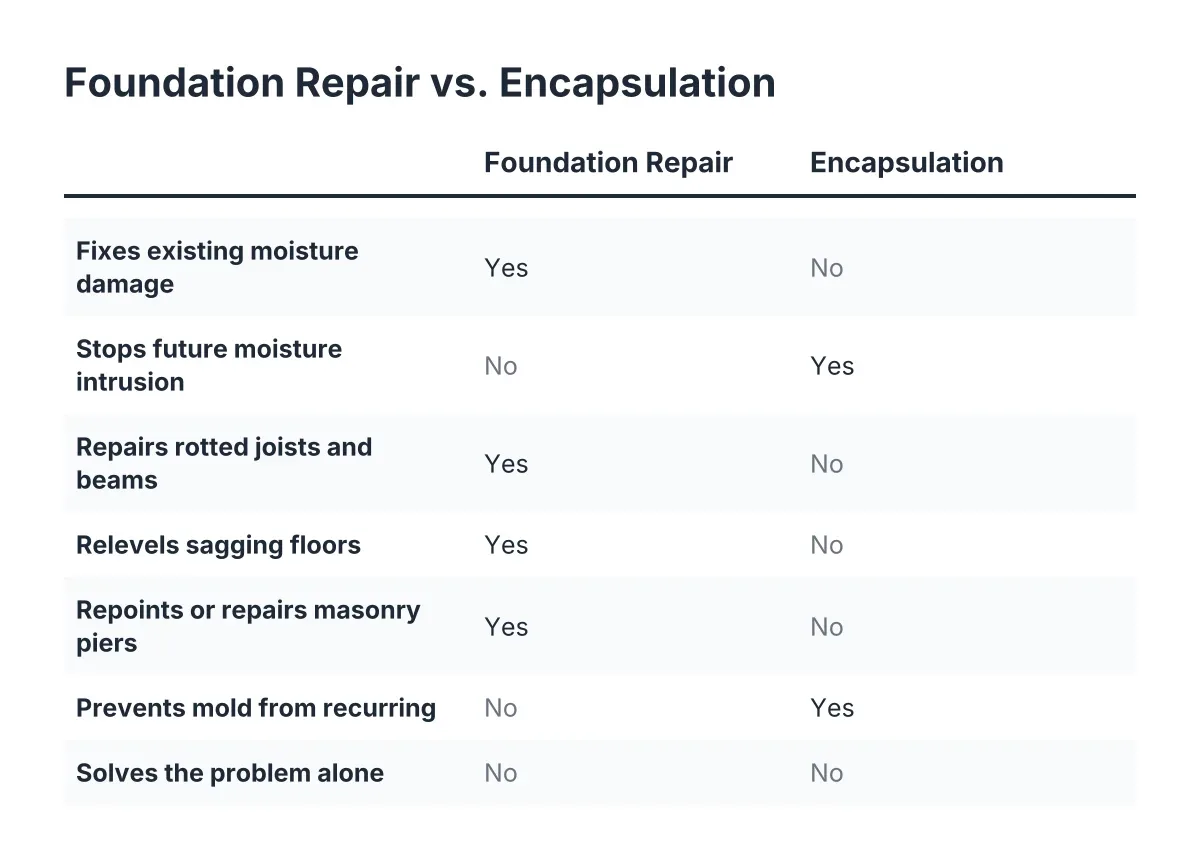
- Structural repair. This is the foundation work itself: sistering or replacing rotted joists, replacing sections of beam, repairing or shimming brick piers, and installing steel support jacks where floors sag. This is licensed-contractor territory, not a handyman job.
- Moisture source control. Fixing the wood without fixing the water wastes money. This can mean grading the crawl space soil, installing a perimeter drain and sump pump, or adding a vapor barrier across the ground.
- Mold remediation. If the inspection report says "evidence of mold," the wood surfaces need cleaning and treatment before anything gets sealed up, and you need documentation that it was done.
- Cleanup and debris removal. Old insulation, fallen ductwork, construction debris, and soaked plastic come out. Buyers' inspectors crawl under houses; a clean space reads as a maintained house.
What is usually extra: finished flooring and baseboards inside the house. Crawl space contractors stop at the structural wood. If a rotted subfloor section comes out, a flooring contractor installs the finished floor afterward. Budget for that separately if your damage reaches the subfloor.
Crawl Space Repair Cost: Labor, Materials, and Scope
Crawl space repair costs depend mostly on three things: how much wood is damaged, how hard the space is to work in, and whether you also need to fix the moisture source. Small, early-stage repairs can land in the low four figures. Widespread rot with drainage work and encapsulation can run well into five figures.
No two houses price the same, so treat everything below as illustrative ranges, not quotes. A real number requires someone under your actual house.
Labor: the biggest line on the invoice
Labor dominates crawl space pricing because the work happens in a tight, dark space, often 18 to 30 inches tall. Every board, jack, and roll of liner gets dragged in by hand. Access difficulty is one of the biggest cost drivers in this trade; a crawl space with 3 feet of clearance and a wide access door costs less to repair than the same damage under a house with 16 inches of clearance and ductwork in the way.
For example, replacing one rotted joist in an accessible crawl space might be a half-day job for two workers. Replacing the same joist behind a web of plumbing in a shallow space could take a full day or more. The lumber costs the same; the labor doubles.
Materials: lumber, steel, and moisture equipment
Materials break into two buckets. Structural materials include treated lumber for joists and beams, steel support jacks, masonry for pier repair, and fasteners rated for damp environments. Moisture control materials include heavy vapor barrier sheeting, drainage pipe and gravel, a sump pump and basin, and a crawl space dehumidifier if the space gets sealed.
As an illustrative estimate, a single adjustable steel support jack installed might run a few hundred dollars, while a full perimeter drain with sump pump is typically several thousand. Encapsulation of the whole crawl space, with sealed vapor barrier, sealed vents, and dehumidification, is usually the largest single-ticket item and commonly runs into five figures for an average Charleston home.
Scope tiers: an illustrative breakdown
Suppose a seller on James Island gets an inspection report flagging "moisture intrusion and evidence of fungal growth on floor joists." Here is how the repair could tier out, with rough illustrative ranges, not quotes:
- Minimal scope. Mold remediation on the affected joists, a ground vapor barrier, and a written clearance report. Often low four figures. This can satisfy a buyer when the wood is stained but still structurally sound.
- Moderate scope. Everything above, plus sistering two or three softened joists and installing support jacks under a sagging beam. Typically mid four figures to low five figures.
- Full scope. Widespread rot requiring beam replacement, pier repair, a perimeter drain and sump pump, and full encapsulation with a dehumidifier. This is a five-figure project on most homes.
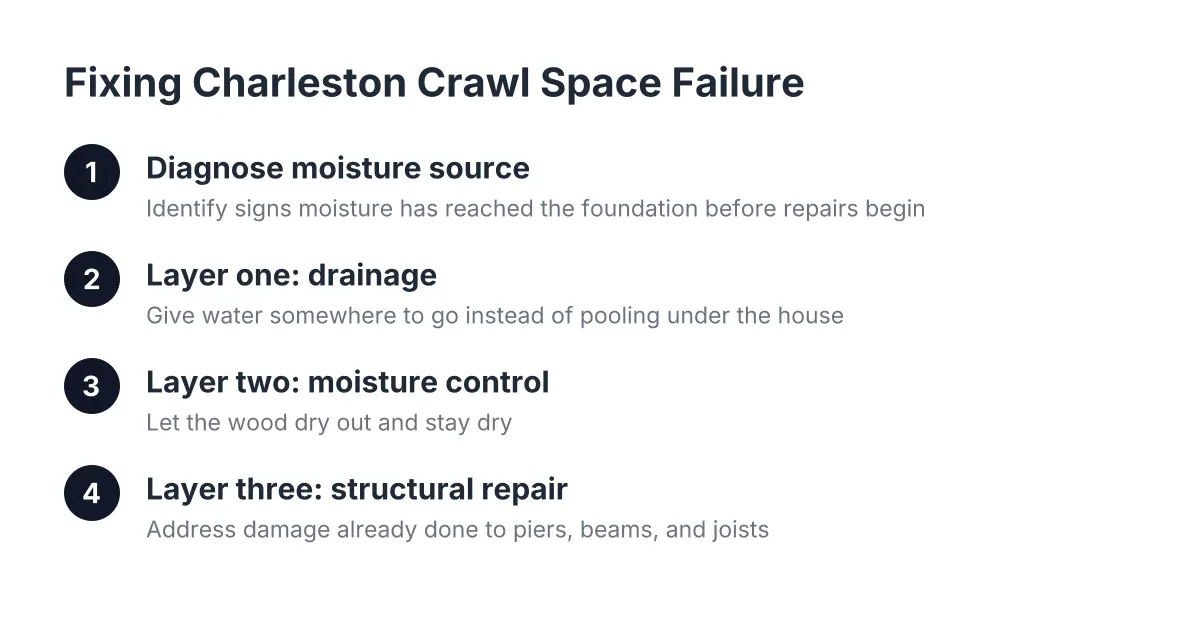
In that scenario, the seller's first question should be which tier the buyer actually requires. A buyer asking for "repair of flagged items with documentation" often needs tier one or two, not tier three. A graduated approach, fixing the structure and the active moisture source first and adding full encapsulation only if needed, keeps the cost matched to the problem.
How long the work takes
Timeline matters when you have a closing date. Hedged generally: mold remediation and a vapor barrier can often be done in a day or two. Structural repairs like joist sistering and support jacks commonly take one to three days depending on access and how many members need work. Full encapsulation with drainage is usually a multi-day project. A local specialist used to pre-sale timelines can usually sequence the must-have items first so documentation is ready before closing.
Pier-and-Beam Repair in Historic Charleston Homes
Repairing a pier-and-beam foundation under a historic Charleston home is a different job than jacking up a 1990s ranch house. The piers may be soft old brick with lime mortar. The beams may be full-dimension heart pine that modern lumber yards do not stock. And the house above has plaster walls and original windows that crack if the structure moves too fast.
Preservation-aware repair means a few specific things in practice:
- Lifting slowly and in small increments. Steel support jacks let a contractor raise a sagging beam gradually, sometimes over multiple visits, so the plaster and trim upstairs survive the correction.
- Repairing piers instead of swapping them for the cheapest alternative. Repointing or rebuilding a brick pier keeps the foundation consistent with the house. Mixing mismatched supports under an old frame invites uneven settling later.
- Matching wood repairs to the original framing. Sistering new treated lumber alongside original full-dimension joists, rather than cutting out more old wood than necessary, keeps the floor system working as designed.
- Respecting the vented design while fixing its flaw. Open foundation vents caused the humidity problem, but sealing a historic crawl space still has to account for drainage, termite inspection access, and local code. Some jurisdictions require a termite inspection strip near the top of the foundation wall to be left uncovered by the vapor barrier, according to Stego Industries, so the installer should confirm Charleston-area requirements before sealing everything.
This is also where you should expect a contractor to tell you when the job exceeds a crawl space scope. Significant pier settlement on a historic structure can call for a structural engineer's assessment before repairs begin. A trustworthy contractor will say so rather than guess, and that engineer's letter often carries weight with a buyer's agent too.
When to Call a Pro and What You Can Handle Yourself
Call a professional for anything structural: rotted or sagging joists, beam damage, leaning or settled piers, or floors that bounce or slope. Structural crawl space work belongs with a licensed contractor; an improvised fix under the house is the kind of thing a buyer's re-inspection catches. Mold remediation before a sale also needs professional documentation to mean anything to a buyer.
However, a homeowner can safely handle some of the surrounding work:
- Redirect downspouts and extend them away from the foundation.
- Fix exterior grading so rainwater flows away from the house, not under it.
- Keep foundation vents and crawl space access doors clear of debris and vegetation.
- Check under the house with a flashlight twice a year for standing water, a stronger musty smell, or new sagging.
Warning signs that mean call now rather than monitor: standing water that does not drain within a day or two of rain, a floor that has visibly dropped, doors upstairs that suddenly will not latch, or a musty smell that has moved from the crawl space into the living space. Each of those usually indicates the damage is active and growing, and advanced rot repairs cost far more than early intervention. In the worst cases, a neglected moisture problem ends with replacing entire runs of subfloor and joists.
One more Lowcountry note on air quality. Crawl space air moves up into the house, which is why mold and musty smells downstairs become complaints upstairs. South Carolina's average indoor radon level is about 1.9 pCi/L, above the national average of 1.3, according to Radon.org. A sealed, properly managed crawl space addresses moisture and improves the air coming up from under the house; it is not a cure-all, but it removes a major source of the problem.
Choosing a Contractor and Reading the Quote
Charleston has no shortage of companies that will quote crawl space work, from national franchises to general contractors who do it occasionally. For foundation-level repairs under an older home, with a closing date attached, screen for three things.
First, ask what they would do and in what order. A specialist will talk about the moisture source before the wood, because replacing a joist without stopping the water means repeating the repair. Listen for a graduated plan: drainage or vapor barrier first, structural repair where the wood demands it, encapsulation and a dehumidifier where the humidity numbers justify it. A quote that jumps straight to the most expensive package without explaining why deserves a second opinion.
Second, ask how they handle pier-and-beam and historic framing. About 15 percent of American homes have a crawl space foundation, according to JSE Labs, but in older Charleston neighborhoods it is the default construction. A contractor who works under these houses weekly will have ready answers about incremental lifting, brick pier repair, and sistering old full-dimension lumber.
Third, ask what documentation you get. For a pre-sale repair, the paperwork is half the product. You want a written scope of work, photos before and after, moisture readings, and an itemized invoice showing exactly what was done. That packet is what turns "evidence of mold in crawl space" on an inspection report into a closed item on the buyer's repair addendum.
A fair quote in 2026 is itemized, explains the why behind each line, separates must-do structural items from recommended moisture upgrades, and puts a realistic timeline next to each phase. Anything vaguer than that makes comparison impossible and makes a stressed seller easy to overcharge.
Getting It Fixed Before the Problem, or the Closing Date, Gets Bigger
Whether you are racing an inspection deadline or you noticed the sag yourself, the economics of crawl space foundation repair reward acting early. A few softened joists and a damp crawl space are a manageable, well-understood repair. The same crawl space ignored for five more humid Charleston summers becomes a subfloor replacement project at several times the price.
If your home is in Charleston or the surrounding communities and your crawl space is damp, musty, or flagged on an inspection report, have a local crawl space specialist look at it. Low Country Crawl Space Repair inspects pier-and-beam crawl spaces, documents what it finds, and provides an itemized estimate for the structural and moisture work your house actually needs. Reach out to schedule an inspection and get a clear scope, timeline, and price before your next deadline arrives.
If you need crawl space encapsulation, Low Country Crawl Space Repair can help.
Prefer to talk it through? Call +18542013678 — a quick call is usually the fastest way to get a straight answer for your situation.